Cabbage Looper
The Cabbage Looper (Trichoplusia ni) is one of the most widespread caterpillar pests affecting vegetables worldwide. Known for its distinctive looping movement, this insect feeds on the leaves of cabbage, broccoli, cauliflower, kale, lettuce, spinach, and many other crops. Heavy infestations can rapidly skeletonize foliage, reduce crop quality, and lower marketable yields. Early identification and integrated pest management (IPM) are the most effective ways to minimize damage.
What is the Cabbage Looper? The Cabbage Looper is the larval stage of the moth Trichoplusia ni. Unlike many caterpillars, it has only three pairs of prolegs, causing it to move by arching its body into a characteristic "loop." Although it prefers plants in the cabbage family, it feeds on more than 160 plant species.
Identification of Cabbage Looper
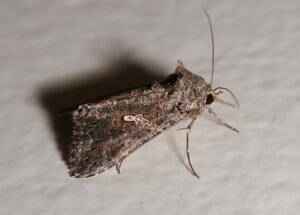
Adult moths have a wingspan of approximately 30–38 mm. They are mottled grayish-brown with a distinctive silvery figure-eight or Y-shaped mark near the center of each forewing.
The larvae are smooth, bright green caterpillars with thin white stripes running along the sides of the body. Mature larvae grow up to 35 mm long and move in a looping fashion because they lack the middle abdominal prolegs found in many other caterpillars.
Eggs are pale green to white, dome-shaped, and laid individually on the undersides of leaves.
Biology & Ecology
The Cabbage Looper undergoes complete metamorphosis through egg, larva, pupa, and adult stages. In warm climates, several generations may develop each year.
Females lay hundreds of eggs on suitable host plants. Newly hatched larvae immediately begin feeding on leaf tissue before progressing through several developmental stages over two to four weeks.
Pupation occurs inside a thin silken cocoon attached to leaves. Adult moths emerge approximately one to two weeks later, depending on temperature.
In practice, gardeners often notice irregular feeding holes long before seeing the caterpillars themselves. The green larvae blend remarkably well with cabbage leaves, making careful inspection necessary to detect early infestations.
Global Distribution
Cabbage Looper is widely distributed throughout North America and has spread to many temperate and subtropical regions worldwide. It is especially problematic in commercial vegetable production and home gardens where leafy vegetables are grown.
Adult moths are strong fliers and migrate considerable distances, allowing new infestations to develop rapidly each growing season.
Risks and Crop Damage
Larvae are responsible for all plant damage by feeding aggressively on leaves.
Common host plants include:
- Cabbage
- Broccoli
- Cauliflower
- Kale
- Brussels sprouts
- Lettuce
- Spinach
- Mustard greens
- Beans
- Tomatoes
Young larvae create small feeding holes, while larger caterpillars consume extensive areas of foliage, often leaving only major leaf veins behind.
A common mistake is assuming that minor leaf damage is insignificant. Because young larvae feed continuously and grow rapidly, small infestations can become severe within only a few days if left unmanaged.
Signs of Cabbage Looper Infestation
Regular scouting allows early intervention before significant crop losses occur. Typical signs include:
- Irregular holes in leaves.
- Skeletonized foliage.
- Green caterpillars on leaf undersides.
- Dark green frass (droppings) on leaves.
- Chewed cabbage heads or broccoli florets.
- Visible looping caterpillar movement.
Control and Prevention Methods
Integrated Pest Management offers the most sustainable long-term control.
- Inspect plants frequently for eggs and young larvae.
- Handpick caterpillars in small gardens.
- Encourage beneficial insects such as parasitic wasps and lacewings.
- Use floating row covers to prevent egg laying.
- Remove crop residues after harvest.
- Apply registered insecticides only when necessary.
- Use biological insecticides containing Bacillus thuringiensis (Bt) against young larvae.
Biological products generally provide the best results when caterpillars are small and actively feeding.
For comparison, see our guide on Imported Cabbageworm and our article about Diamondback Moth, two other important pests of brassica crops.
Advanced Professional Approaches
Commercial vegetable producers rely on routine field scouting, pheromone trapping, biological control, economic thresholds, and selective insecticides to minimize crop losses while protecting beneficial insects.
What most people don't realize is that broad-spectrum insecticides can eliminate natural predators that normally suppress Cabbage Looper populations. In many cases, preserving beneficial insects results in better long-term control than repeated pesticide applications.
Frequently Asked Questions
What is the Cabbage Looper?
The Cabbage Looper is the caterpillar stage of the moth Trichoplusia ni, a common pest of cabbage and many other vegetables.
Is the Cabbage Looper harmful to humans?
No. It does not bite people or spread diseases, but it can severely damage vegetable crops.
Which plants are most commonly attacked?
Cabbage, broccoli, cauliflower, kale, lettuce, spinach, Brussels sprouts, and other leafy vegetables are among its preferred hosts.
How does the Cabbage Looper spread?
Adult moths migrate between gardens and agricultural fields, laying eggs on suitable host plants throughout the growing season.
What is the best treatment for Cabbage Looper?
Integrated Pest Management combining monitoring, biological control, hand removal, row covers, and properly timed applications of Bacillus thuringiensis (Bt) provides excellent control.
Can beneficial insects control Cabbage Looper?
Yes. Parasitic wasps, lacewings, predatory bugs, spiders, and birds naturally reduce Cabbage Looper populations in many gardens and farms.
Final Thoughts
Cabbage Looper remains one of the most important pests affecting leafy vegetables worldwide. Early monitoring, accurate identification, and integrated pest management provide the best protection for both home gardens and commercial vegetable production while minimizing unnecessary pesticide use.
Disclaimer
This article is for informational purposes only. Food safety (HACCP) and pest control requirements vary by country, authority, and type of food business. For legal compliance and audit readiness, always consult a qualified HACCP professional and a licensed pest control operator in your area.
All pest control measures must use approved products and be applied strictly according to the product label, as required by law in most jurisdictions (including the EU, UK, and USA). Improper use of pesticides, lack of documentation, or absence of a structured pest monitoring program may lead to non-compliance, fines, or business closure.
A compliant system must include documented procedures, monitoring records, corrective actions, and verification. Pest control is not optional—it is a core prerequisite program under HACCP and must be properly implemented, recorded, and reviewed.
Author Bio
BSc Agronomist & Certified Pest Control Expert
Scientific Director – Advance Services (Athens, Greece)
Licensed Pest Control Business – Ministry of Rural Development & Food (GR)