Mosquito Larvae – Identification, Prevention and Control
 I have inspected many backyards, hotel gardens, and drainage systems during my career. One of the most common things I find is the mosquito, in all phases of its life from the young mosquito larvae living in water to the adult flying mosquitoes. Mosquitoes in their first stages grow quietly in standing water, like plant saucers, gutters, buckets, fountains, piscines or even small bottle caps.
People usually complain about adult bites, but controlling mosquito larvae is the key to stopping infestations early before they start. Once they become flying adults, their management is far harder and more expensive and needs repeated treatments. Understanding how and where larvae live gives you the advantage to control the infastation from its root.
Identification
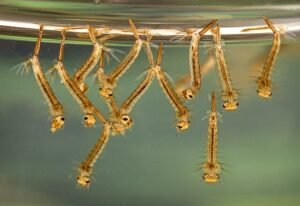
Mosquito larvae are easy to recognize if you know how and what to look for. These baby mosquitos sometimes are called “wrigglers” because of their funny swimming motion.
Typical features:
-
Size: 4–10 mm long.
-
Color: Pale gray to dark brown, almost transparent in some species.
-
Body: Segmented with a large rounded head, thorax, and narrow abdomen.
-
Movement: They hang just below the surface, moving with quick wriggles.
-
Breathing: Most species (like Culex pipiens) use a small siphon tube to breathe atmospheric air. The exception is Anopheles, which lies parallel to the surface without a siphon. New reviews suggest that some mosquitoes larvae like aedes aegypti and aede albopictus can breathe even under the water.
When you move the water, the larvae quickly swim down and come back up after a few seconds. You can easily see them in flower pots, old tires, birdbaths, or roof gutters. When we check the waters we use a special cup to collect waters from drainage and gutters and then we count siphons.
Biology & Ecology
Mosquitoes complete metamorphosis is: egg → larvae → pupa → adult. The larval stage is the feeding and growing phase.
-
Living in: Any still water lasting more than five days — clean, dirty, fresh are suitable.
-
Feeding: They filter to eat microscopic algae, organic debris, and bacteria.
-
Oxygen: They must surface regularly to breathe through their siphon or spiracle. So they need the surface to be free.
-
Temperature: Development is fastest between 25 and 30 °C, when they grow at their optimum rate.
-
Duration: From egg to adult 7 days is enough for them in warm weather.
Larvae needs the water, so removing the standing water is the most effective mosquito control method for mosquitoes larvae.
Global Distribution
Mosquito larvae are found worldwide, wherever we have standing water .
-
Europe & North America: Common species include Culex pipiens and Aedes vexans.
-
Tropics & Subtropics: Aedes aegypti and Aedes albopictus breed in urban containers.
-
Asia & Africa: Anopheles gambiae larvae prefer cleaner water such as rice fields
-
Australia: Dozens of native Aedes species.
Every region faces the same pattern, if standing water is present, mosquito larvae will soon appear. That’s why many countries and states run often mosquito control programs, including aerial spraying, larviciding, and of course public awareness campaigns..
Risks / Damage
Mosquito larvae themselves do not bite or transmit disease, we try to control them beacause they are the stage that produces the adult females responsible for bites and mosquito-borne diseases to be spread.
Main concerns:
-
Public-health risk: Each larva represents a future biting adult.
-
Nuisance: High larval density means heavy adult emergence nearby.
-
Environmental impact: Large infestations near farms or fishponds may disturb aquatic balance by depleting oxygen and blocking sunlight.
For households or food businesses, breeding mosquitoes can quickly become a reputation problem, especially around outdoor dining areas.
Signs of Infestation
Typical indicators include:
-
Visible “wiggling” larvae in any standing water container.
-
Pupal skins (tiny comma-shaped casings) floating on the surface.
-
A sudden increase in adult mosquitoes around the property after rain.
-
Clusters of eggs along the edges of buckets, gutters, or barrels.
Regular inspection of small water sources is the fastest way to detect a problem early.
Mosquito Control & Prevention Methods
1. Eliminate Standing Water
The golden rule: “Tip it, drain it, or cover it.”
Empty flower-pot saucers, buckets, toys, and birdbaths every few days if possible. Keep gutters clean and ensure tanks are sealed.
2. Introduce Biological Control
Certain fish species such as Gambusia affinis (mosquito fish) eat larvae effectively. They are ideal for ornamental ponds and reservoirs.
3. Use Larvicides When Needed
Biological larvicides based on Bacillus thuringiensis israelensis (Bti) or Bacillus sphaericus are selective, safe for people and pets, and approved worldwide.
Better to be applied by licensed pest control professionals, only in non-drinking water, and always according to the product label instructions.
4. Maintain Outdoor Cleanliness
Trim vegetation near drains and in th yards, avoid litter buildup, get rid of clutters and keep irrigation systems from creating puddles.
5. Cover Water Storage and Rain Barrels
Use fine-mesh screens or tight lids. Adult mosquitoes can lay eggs in just a few millimeters of exposed water.
These steps can reduce mosquito larvae by more than 90 % without even use an ml of chemical.
Advanced / Professional Approaches
As a pest-control professional, my work often involves surveying and mapping breeding sites according the IPM spirit rather than spraying blindly.
Professional actions include:
-
Larval monitoring: Using dippers to monitor populations and species type.
-
Targeted larvicide applications: Αpplied only where needed.
-
Insect growth regulators (IGRs): Compounds that stop larvae from maturing into adults.
-
Standing watersfd reduction plans: Working with property owners to modify drainage or cover water tanks.
Integrated Mosquito Management (IMM) programs focus on data, prevention, and minimum pesticide use.
Cultural / Historical Context
Human societies have battled mosquitoes for centuries. Ancient Egyptians wrote about swamp control along the Nile; Romans drained marshes to protect settlements. In modern times, community cleanup campaigns remain one of the most effective mosquito-control measures. The message is ancient but true — control the water, and you control the mosquitoes.
FAQ
1. What do mosquito larvae look like?
They are small wriggling creatures living in water, with a big head and narrow tail.
2. Where do mosquito larvae live?
Any still water — flower pots, tires, clogged drains, rain barrels, or puddles.
3. Can mosquito larvae live in clean water?
Yes. Species like Aedes aegypti can thrive even in clean tap water.
4. Do mosquito larvae bite?
No. Only adult females bite. Larvae feed on microorganisms.
5. How long does it take for larvae to become mosquitoes?
Usually 7–10 days in warm weather; longer in cooler conditions.
6. How can I kill mosquito larvae naturally?
Add Bti larvicide or a small amount of dish soap to standing water (not for drinking use). Fish also eat larvae efficiently.
7. Are mosquito larvae dangerous to humans?
Not directly, but they grow into adults that can bite and transmit diseases.
8. When should I call a professional?
If mosquitoes appear continuously despite cleaning and draining water, a professional inspection can identify hidden breeding sites such as roof gutters, septic systems, or storm drains.
Learn more about Wildlife & Vertebrate Pests
Final Thoughts
Over the years, I have inspected many gardens, hotels, and residential areas, and almost every mosquito problem I found started from one simple thing — standing water. People often focus on adult mosquitoes flying around, but the real battle is in the larval stage. If you stop larvae, you stop the adults.
Good mosquito management doesn’t mean spraying everything. It means understanding biology, finding hidden water sources, and using environmentally responsible methods like Bti larvicides, mosquito fish, and proper drainage. Most infestations can be eliminated with inspection and maintenance, not chemicals.
Controlling mosquito larvae is simple once you know what to look for. One bucket, one gutter, or one plant saucer can breed hundreds of mosquitoes in a week. Regular checks and prevention protect your home, your customers, and your community.
Disclaimer
This article is for informational purposes only. Pest control laws and approved chemicals vary by country. For best results and legal safety, we strongly recommend contacting a licensed pest control professional in your local area. Always make sure that the pest control technician is properly certified or licensed, depending on your country’s regulations. It’s important to confirm that they only use approved products and apply them exactly as instructed on the product label. In most places in Europe, the UK, or the USA, following label directions is not just best practice—it’s the law.
Author
Nasos Iliopoulos
BSc Agronomist & Certified Pest Control Expert
Scientific Director – Advance Services (Athens, Greece)
Licensed Pest Control Business – Ministry of Rural Development & Food (GR)
References
-
Penn State Extension - Mosquito Life Cycle and Control Strategies. (viseo)