Scolopendra gigantea – The Amazonian Giant Centipede
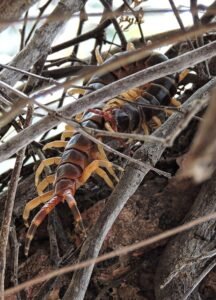
I have studied many reports from tropical regions where people were terrified by a long, fast-moving creature crawling under furniture or hiding behind a rock. In most cases, it was Scolopendra gigantea, the Amazonian giant centipede the most iconic giant centipede, also known as the Peruvian giant yellow-leg centipede . This species is one of the largest and most feared arthropods in the world. Although it looks very aggressive and ugly, it is an important predator in tropical ecosystems that helps the ecosystem to control the insects population. Understanding its biology and lifespan helps explain why it rarely becomes a true pest and why control is needed only in certain situations.
Identification of Scolopedra Gigantea or the Amazonian piant Centipede
Scolopendra gigantea is easily recognized by its size and color. Adults can exceed 25–30 cm or 12 inches in length, with a flattened, segmented body and 21–23 pairs of legs. The body color varies from dark brown to reddish, often with yellow or orange legs. The first pair of legs is modified into venom claws (forcipules), used to inject venom into prey. Unlike millipedes, which move slowly and feed on decaying matter, centipedes are active hunters.
In the same genus, there are smaller relatives such as Scolopendra subspinipes, common in Southeast Asia, and Scolopendra morsitans, found in Africa and parts of the Mediterranean. These species share similar habits but are less massive than S. gigantea.
Biology & Ecology
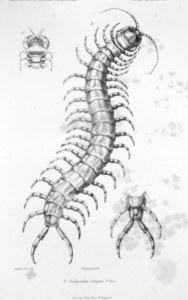
The Amazonian giant centipede is a nocturnal predator that hunts insects, spiders, lizards, small rodents, and even birds. It uses speed and venom to paralyze its prey. After injecting venom, it consumes the animal slowly using its strong jaws.
It prefers warm, humid environments such as rainforests, caves, or dark corners of tropical houses. During the day, it hides under rocks, bark, or debris to avoid dehydration. It does not build nests or webs.
Reproduction occurs mainly during the wet season. The female lays 15–50 eggs in moist soil or rotting wood and guards them until hatching. The young centipedes look like miniature adults but have fewer segments. They molt several times before reaching full size.
Giant centipedes lifespan is relatively long for an invertebrate — up to 5–7 years in natural conditions and even 10 years in captivity.
Global Distribution
Scolopendra gigantea is native to northern South America, Trinidad and Tobago, Puerto Rico, Venezuela, Colombia, and the Caribbean islands. It also appears in Central America and parts of Brazil.
In Europe, it does not occur naturally, but related species such as Scolopendra morsitans live in the Mediterranean region, including southern Spain, Greece, and North Africa.
Risks / Damage
The main concern with Scolopendra gigantea is its bite. The venom is strong enough to subdue small animals and can cause intense pain, swelling, and redness in humans. However, serious reactions are rare, and fatalities are extremely uncommon.
Unlike termites, cockroaches, or mice, giant centipedes do not damage structures or stored food. Their risk is mostly psychological and medical, especially when they enter houses, hotels, or tourist lodges.
People working in tropical warehouses, plant nurseries, or old buildings may occasionally find them hiding in moist areas, behind boxes, or under stones.
Signs of Infestation
Because these centipedes are solitary and nocturnal, true infestations are rare. You may suspect their presence if you find:
-
Large molted skins near walls or corners.
-
Fast movement of a reddish centipede when you lift debris or move objects.
-
Unusual bites in tropical areas, typically on hands or feet when someone disturbs their hiding place.
-
Prey remains (dead insects, small lizards) near dark, humid spots.
Control & Prevention Methods
Controlling Scolopendra gigantea is mainly about habitat reduction. Chemical control is rarely justified.
Prevention steps:
-
Remove clutter and debris around homes, especially in tropical gardens or basements.
-
Seal cracks and entry points in walls, drains, or floors.
-
Reduce humidity with ventilation or dehumidifiers.
-
Avoid leaving pet food or insects around lights at night.
-
Inspect imported goods or plant materials from tropical regions.
If one is found indoors, it can be captured using a container and released outside. Always wear gloves — their bite can penetrate skin.
Advanced / Professional Approaches
When centipedes are repeatedly entering homes or tourist facilities, professional pest control may be necessary. Treatments usually involve:
-
Residual insecticides (pyrethroid-based) applied along skirting boards and wall junctions.
-
Perimeter spraying around foundations or garden walls.
-
Dust formulations (silica or boric-based) inside cracks and crevices.
Professional technicians also inspect for moisture sources and pest populations that attract centipedes, such as cockroaches, ants, or silverfish. Reducing those prey species indirectly reduces centipede numbers.
Cultural or Historical Context
In several South American cultures, Scolopendra gigantea is both feared and respected. Some indigenous tribes used its venom in traditional medicine or as part of rituals, believing it carried protective power. In modern times, its image is used in films, horror stories, and museum exhibits as a symbol of tropical wilderness.
FAQ Section
Q1: Is the bite of Scolopendra gigantea dangerous to humans?
It is painful but rarely dangerous. Most reactions are local and disappear in a few days.
Q2: Can it live in Europe or North America?
No, it needs constant heat and humidity. However, related species can survive in warm regions or indoors.
Q3: What should I do if I find one in my house?
Do not panic. Capture it carefully in a container and release it outdoors, or call a pest control professional if unsure.
Q4: Does it eat cockroaches or other household pests?
Yes, it feeds on insects like cockroaches, crickets, and even small vertebrates.
Q5: Can insecticides kill giant centipedes?
Yes, but they are resistant to many sprays. Targeted residual treatments by professionals are most effective.
Q6: How long can they live this giant centipede?
On average, between 5 and 7 years in the wild, and up to 10 years in captivity.
Final Thoughts
After reading and studying many reports, I can say that Scolopendra gigantea is one of nature’s most misunderstood predators. It looks terrifying but plays an essential role in controlling tropical insect and small animal populations. It rarely becomes a pest and almost never attacks humans unless handled.
For homeowners or facility managers in tropical regions, prevention is simple: keep areas dry, remove clutter, and reduce food sources such as cockroaches or crickets. Chemical treatments should be used only when centipedes repeatedly enter buildings.
Understanding its lifespan, habits, and limits helps to avoid unnecessary fear. The giant centipede is not an invader—it is a survivor of millions of years of evolution.
Learn more about other agricultural and outdoor pests that affect gardens and crops.
Disclaimer
This article is for informational purposes only. Pest control laws and approved chemicals vary by country. For best results and legal safety, we strongly recommend contacting a licensed pest control professional in your local area. Always make sure that the pest control technician is properly certified or licensed, depending on your country’s regulations. It’s important to confirm that they only use approved products and apply them exactly as instructed on the product label. In most places in Europe, the UK, or the USA, following label directions is not just best practice—it’s the law.
Author
Nasos Iliopoulos
BSc Agronomist & Certified Pest Control Expert
Scientific Director, Advance Services (Athens, Greece)
Licensed Pest Control Business – Ministry of Rural Development & Food (GR)
References
-
Britannica - giant centipede
-
PubMed Central - An unusual two-stage infection following a scolopendra bite
-
Haddad Jr., V. et al. (2016). Bites by centipedes of the genus Scolopendra in humans. Toxicon, 119, 100–105.
-
Cloud, J. A., & Jennings, D. T. (2018). Large tropical centipedes: Identification and management. University of Florida IFAS Extension.
-
González-Sponga, M. A. (2004). Arthropods of Venezuela: Scolopendromorpha. Universidad Central de Venezuela.