Tarantulas as Pests: Identification, Risks, and Control
 I have never personally encountered tarantulas during my work, but many pest control colleagues in tropical and subtropical regions receive reports from people who panic after spotting large, hairy spiders around gardens, walls, or storage areas. In some of those cases — not all — the spider turns out to be a tarantula (family Theraphosidae), also known as bird spider, baboon spider, or hairy mygalomorph.
These impressive arachnids are related to wolf spiders, trapdoor spiders, and funnel-web spiders, but they are much larger and slower. Tarantulas rarely enter homes, preferring to live outdoors in burrows, crevices, or under stones. Still, their intimidating size and appearance often cause alarm when they are found close to human areas, even though they are not aggressive and their bite is rarely dangerous.
Identification
Tarantulas belong to over 1,000 known species worldwide. They vary in color, size, and behavior, but most share the same features:
-
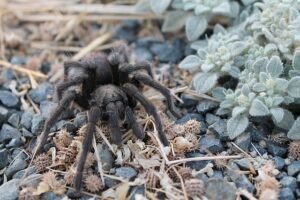
Large, hairy body up to 10 cm long (with legs reaching 25–30 cm in some species).
-
Eight eyes arranged in a small cluster.
-
Thick, strong legs covered with sensory hairs.
-
Slow, deliberate movement.
Common species include:
-
Aphonopelma hentzi – Texas brown tarantula (North America)
-
Brachypelma smithi – Mexican redknee tarantula (Central America)
-
Grammostola rosea – Chilean rose tarantula (South America)
-
Poecilotheria regalis – Indian ornamental tarantula (Asia)
-
Haplopelma lividum – cobalt blue tarantula (Southeast Asia)
-
Theraphosa blondi – Goliath birdeater (South America)
Biology & Ecology
Tarantulas are nocturnal hunters that live in burrows, cracks, or under stones and logs. They feed mainly on insects, small reptiles, and even small rodents. Most species live alone and defend their burrow aggressively. Females can live up to 20 years, while males survive for a few years only.
Tarantulas prefer warm and dry or slightly humid environments. During the breeding season, males wander in search of females and may accidentally enter homes or buildings.
Global Distribution
Tarantulas are found in tropical and subtropical regions around the world:
-
North America: Southern United States (Texas, Arizona, New Mexico, California).
-
Central & South America: Mexico, Brazil, Chile, Venezuela, Peru.
-
Asia: India, Sri Lanka, Myanmar, Thailand, and Malaysia.
-
Africa: Various Hysterocrates species in tropical zones.
-
Australia: Native species like Selenocosmia crassipes are common in the north and east.
In Europe, they are rare but some related large mygalomorph spiders occur in Mediterranean countries.
Risks / Damage
Tarantulas are not real pests in the agricultural sense, but they can become a nuisance pest in homes or facilities. The main issues include:
-
Fear and discomfort – People panic at the sight of a large spider.
-
Mild venomous bite – Painful but not dangerous for healthy adults.
-
Urticating hairs – Some species (like Brachypelma or Theraphosa) flick tiny barbed hairs that can irritate the skin or eyes.
-
Contamination in storage areas – Dead tarantulas or shed skins can cause allergic reactions.
They do not damage structures, but their presence inside buildings can be alarming and lead to unnecessary insecticide use.
Signs of Infestation
Tarantulas rarely form large infestations, but signs include:
-
Seeing a single large spider, especially at night.
-
Finding shed exoskeletons near cracks or under stored items.
-
Burrows near building foundations or garden edges.
-
Webbing around holes in soil or between stones (depending on species).
If you live in a warm region and notice these signs repeatedly, it indicates nearby burrows or active populations in the area.
Control & Prevention Methods
Most tarantulas enter accidentally. The key is prevention and habitat modification:
-
Seal cracks and entry points around foundations, doors, and windows.
-
Reduce outdoor clutter such as stones, firewood, and leaf piles near the house.
-
Keep lighting low since outdoor lights attract insects, which attract spiders.
-
Inspect items like pots, boxes, or logs before bringing them indoors.
-
Vacuum and clean regularly to discourage hiding spots.
For outdoor management:
-
Remove old debris, mulch, or woodpiles.
-
Keep lawns trimmed and reduce insect populations (their food source).
-
Natural predators like birds, lizards, and some wasps help control them naturally.
Advanced / Professional Approaches
Professional pest control for tarantulas focuses on exclusion, sanitation, and targeted treatments.
-
Residual insecticide sprays may be applied around building perimeters, cracks, and burrow entrances.
-
Dust formulations (e.g., diatomaceous earth or silica) are effective in wall voids or under structures.
-
Monitoring with glue traps helps detect indoor movement.[
Unlike other pests, chemical control is secondary to habitat modification. In many tropical regions, technicians focus on removing environmental attractants rather than killing individual tarantulas.
Cultural or Historical Context
Tarantulas have long been subjects of fear and fascination. In parts of Italy, the medieval “tarantella dance” was said to cure the effects of a mythical tarantula bite (actually caused by a wolf spider). In contrast, in modern culture, tarantulas are popular as exotic pets — even though escaped or released individuals can cause local concern.
FAQ Section
Are tarantulas dangerous to humans?
In contrast to popular belief, most tarantulas are not aggressive, and their venom is mild. The bite can be painful but rarely serious. These large spiders rely more on intimidation — their size, hairiness, and defensive posture — than on actual aggression. Only when or provoked will a tarantula defend itself.
Can tarantulas infest houses?
Not in the same way as insects. They may enter houses accidentally, especially during mating season or after rain.
Do tarantulas bite pets?
They may bite if provoked, but such cases are rare. Small pets should be kept away from wild tarantulas.
How long do tarantulas live?
Females can live up to 20 years; males only a few years.
How do I get rid of a tarantula in my house?
Trap it with a jar or container and release it outdoors. For repeated sightings, contact a pest control professional.
Are tarantulas common in the USA, Europe, and Australia?
Yes, especially in warm regions. In the USA, species like Aphonopelma hentzi are common; in Australia, Selenocosmia crassipes is widespread; in Southern Europe, smaller relatives may exist.
What attracts tarantulas?
Insects, shelter, and warmth. They follow their prey into gardens, garages, or basements.
Final Thoughts
Tarantulas are not real pests in the way termites or cockroaches are. They are slow, solitary hunters that usually enter homes by accident. In most regions, they play an important ecological role by reducing the population of insects and other arthropods. Still, their large size and sudden movement can cause fear, especially when found indoors.
In pest control, the best approach is always prevention — keeping cracks sealed, managing outdoor clutter, and reducing moisture. When sightings are repeated or involve exotic species, it is best to consult a licensed professional who understands safe and humane spider management.
Learn more about other agricultural and outdoor pests that affect gardens and crops.
Disclaimer
This article is for informational purposes only. Pest control laws and approved chemicals vary by country. For best results and legal safety, we strongly recommend contacting a licensed pest control professional in your local area. Always make sure that the pest control technician is properly certified or licensed, depending on your country’s regulations. It’s important to confirm that they only use approved products and apply them exactly as instructed on the product label. In most places in Europe, the UK, or the USA, following label directions is not just best practice—it’s the law.
Author
Nasos Iliopoulos, BSc Agronomist & Certified Pest Control Expert
Scientific Director – Advance Services (Athens, Greece)
Licensed Pest Control Business – Ministry of Rural Development & Food (GR)
References
-
National Geographic - Tarantulas
-
National Library of Medicine - Tarantula Spider Toxicity