Are European Hornets Dangerous?
 European hornets (Vespa crabro) are the largest social wasps found in Europe and parts of North America. They often cause fear because of their loud flight, size, and painful sting. Many homeowners contact pest control professionals asking, “Are European hornets dangerous?” The truth is that while European hornets can sting and defend their nest aggressively, they are usually not dangerous unless provoked. Of course, every colony can behave differently. I remember one case where I treated a european hornet nest hidden inside a dishwasher. Even before I started the treatment and I was still several meters away, the hornets sensed my presence. Within seconds, the entire colony was out, guarding the nest so actively that I felt they could sting me through my protective suit. It was one of those times when you truly respect and fear their defensive instinct.
European hornets are sometimes confused with paper wasps, yellowjackets, or even Asian hornets, but their behavior and control methods differ. Linking these related species helps readers identify the right pest and find accurate treatment information.
Identification
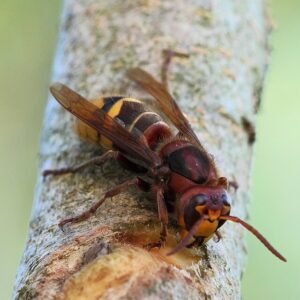
European hornets are large, measuring up to 3.5 cm (1.4 inches) in length. They have a yellow abdomen with brown or reddish stripes, a reddish-brown thorax, and transparent brownish wings. Their heads are broad with large eyes and strong mandibles. These insects often get confused with Asian hornets (Vespa velutina), but European hornets have lighter yellow faces and are generally less aggressive.
Biology & Ecology
European hornets are social insects that live in colonies of up to 500–700 individuals. The queen starts a new nest in spring, often in hollow trees, wall cavities, attics, or abandoned bird boxes. The nest is made of chewed wood fibers, forming a paper-like structure.
They are predatory insects, feeding mainly on flies, caterpillars, and other small insects. In some cases, they become a serious problem for beekeepers, as they may attack and kill honeybees near hives. Adult hornets also feed on tree sap, overripe fruit, and nectar, especially during late summer when insect prey becomes scarce. Colonies naturally die out in late autumn, leaving only fertilized young queens to overwinter and build new nests the following spring.
Global Distribution
Native to Europe and parts of Asia, Vespa crabro was accidentally introduced to North America in the 19th century and is now established across the eastern United States and southern Canada. They prefer wooded areas, rural gardens, and structures near forests.
Risks & Damage
European hornets can sting repeatedly, and their venom can cause pain, swelling, and allergic reactions. However, they are not inherently aggressive and usually attack only when their nest is disturbed.
Main risks include:
-
Painful stings for humans and pets.
-
Allergic reactions in sensitive individuals (rarely severe).
-
Structural damage, as hornets may chew on wooden surfaces or bark to obtain fiber.
-
Food contamination, if they enter kitchens or outdoor eating areas.
They are beneficial in nature because they control pest insects, but in or near homes, they pose a safety concern.
Signs of Infestation
-
Frequent sightings of large hornets entering or leaving a hole in a wall, tree, or attic.
-
Audible buzzing or drumming sounds from inside hollow spaces.
-
Shredded wood or bark near nest entrances.
-
Dead insects or hornets accumulating around windows or lights.
Control & Prevention Methods
-
Do not approach or disturb nests. European hornets defend aggressively within several meters of their colony.
-
Seal wall cracks and attic openings in early spring to prevent nest building.
-
Keep outdoor lights off at night when possible, as hornets are attracted to light.
-
Remove fallen fruit and secure garbage bins to reduce food sources.
-
For active nests near living areas, contact a licensed pest control expert. Do not use aerosol sprays or knock down nests yourself, especially if allergic to stings. The certified anf trained pest controler follows special strict protocol for removing the european hornet nest minimizing risk for people and pets.
Advanced / Professional Approaches
Professional pest control operators use protective equipment and apply residual insecticides or dust formulations directly into the nest entrance. In some cases, nighttime removal is preferred, as hornets are less active.
After treatment, the entry point is sealed to prevent new colonies. In protected environments like schools or hospitals, environmentally safe insecticides and CO₂ treatments may be used.
FAQ
Q1: Are European hornets dangerous to humans?
A: Only if disturbed. Their sting is painful but rarely serious unless you are allergic.
Q2: Are European hornets aggressive?
A: No, they are calm unless their nest is threatened. They prefer to avoid confrontation.
Q3: Can European hornets damage property?
A: Slightly. They may chew wood or bark, but damage is usually minor.
Q4: How can I get rid of European hornets safely?
A: Avoid DIY removal. Hire a professional who can apply the correct insecticide at night.
Q5: Do European hornets attack bees?
A: Yes, they ofter prey on honeybees, especially in late summer. They can sometimes destroy the whole beehive.
Q6: Why do European hornets fly at night?
A: They are one of the few wasp species active after dark, attracted to lights and windows.
Final Thoughts
European hornets (Vespa crabro) are impressive and often misunderstood insects. While their sting can be painful, they rarely attack without reason. In most cases, they are beneficial predators, helping control pest insect populations in gardens and forests. However, when they nest close to homes, schools, or businesses, they must be handled with care.
If you suspect a nest nearby, avoid disturbing it and contact a licensed pest control expert. Proper protective gear and professional-grade insecticides are essential for safe removal.
Disclaimer
This article is for informational purposes only. Pest control laws and approved chemicals vary by country. For best results and legal safety, we strongly recommend contacting a licensed pest control professional in your local area. Always make sure that the pest control technician is properly certified or licensed, depending on your country’s regulations. It’s important to confirm that they only use approved products and apply them exactly as instructed on the product label. In most places in Europe, the UK, or the USA, following label directions is not just best practice—it’s the law.
Nasos Iliopoulos, BSc Agronomist & Certified Pest Control Expert
Scientific Director – Advance Services (Athens, Greece)
Licensed Pest Control Business – Ministry of Rural Development & Food (GR)
References
-
Penn State Extension – European Hornet Factsheet
-
University of Kentucky Entomology – Controlling Wasps, Hornets, and Yellowjackets