
Case Study from the Field: Thousands of Ants in the Yard of Brand-New House
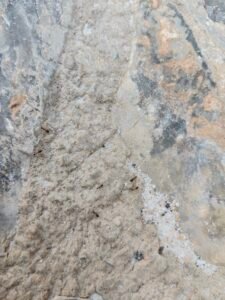
A brand-new house stylish, lean, modern, still smelling of fresh paint. And within a few minutes of sitting outside with a coffee, thousands of ants covering the table, the chair, the cup, your arms.
This is what happened to a couple who called me for a professional ant infestation in both their front and back garden.
This is a real incident from the field.
The First Visit Was Delayed Two Months
They had actually contacted me about two months earlier. One of their children got sick, so the appointment was postponed.
They could have called another company in the meantime. They didn't. When they were ready called me again cause they had heard some good words for me.
The First Clue of Ants, Before I Even Entered the House
While I was still ringing the doorbell, I already had my first piece of evidence on my feet: a continuous trail of ants along the ground, coming from the public road, crossing the sidewalk, entering through the property gate, running the full length of the front path, into the flower bed, and up the building's exterior thermal insulation (EIFS).
I hadn't heard a single word from the owners yet. The ants had already told me most of what I needed to know.
A Phone Call in the Middle of the Inspection
While I was explaining my plan of action, my phone rang. My wife — she had just been accepted to the vocational school she wanted for aesthetics studies. We all could hear how happy she was even through the phone.
The owners smiled and asked me to pass on their congratulations. Then we went back to the ants.
Why Gel for Ants & Not Spray
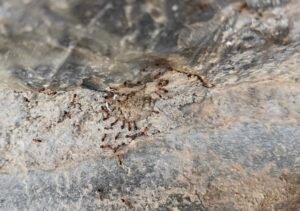
My first decision was professional ant gel, placed directly on the foraging trails — not a general spray. Spraying a visible trail kills the worker ants you can see and does nothing for the colony behind it, sometimes making things worse by scattering foragers into new routes.
The owners' response: "You're the scientist. Do what you think is right." I hear this often. It's a responsibility, not a compliment.
I applied gel at the entrance, beside the flower bed, at multiple points along the thermal insulation, near the stairs, under sections of the artificial turf, and anywhere else the workers were likely to pass on the way back to the nest.
One detail worried me specifically: the point where the thermal insulation met the soil was poorly finished — an easy vertical route upward. I added a line of diatomaceous earth along that contact point with the wall, and another line where the public road meets the sidewalk, to reduce the population before it ever reached the property.
Another matter that compicated the case was that three days before my visit, a contractor had covered both gardens with a loose gravel-based fill and installed artificial turf over it.
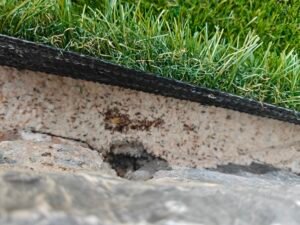
This mattered technically. If there were colonies already established somewhere in the middle of either garden, they hadn't yet had time to tunnel to the edges where I could actually see and treat them. One garden was around 50 m², the other 100-150 m². I explained this directly to the owners: today I can only treat what is active and visible. If other colonies exist under that fill, they're blind to the edges of the garden right now, they haven't found the boundary yet. New trails will surface there over the following weeks, and we treat those when they appear. I explain this on every job involving recent landscaping, so the customer doesn't assume a treatment has "failed" when what actually happened is a colony simply reaching the edge on its own timeline.
The Back Garden Had Other Spieces as Well
In the back garden I found both ants and a larger black ant species, in much smaller numbers and not causing real problems.
I applied gel wherever active trail activity was visible in the back garden, and explained again about the gravel-based fill and artificial turf: any colonies still hidden beneath it hadn't yet found the garden's edges, so today's treatment only covers what's already surfaced.
Up to the First Floor
From the thermal insulation, the ants reached the front balcony, entered under the marble threshold of the balcony door, travelled under the bed, and continued to the bathroom.
Road to bathroom: roughly 20-30 meters of active foraging distance. That's the kind of number that makes a homeowner understand the scale of what they're dealing with better than any adjective I could use.
I applied baits again. In spots where children or pets could reach the bait, I used enclosed professional bait stations with gel inside rather than open application.
What I Told Them Before Leaving
I explained the maintenance logic clearly: if the colony is small, one treatment can be enough. If we're dealing with satellite colonies and multiple queens — which is common with ants and one of the reasons they're difficult — one application won't do it. In that case, follow-up visits every 16 days until the colonies collapse or activity drops to a non-issue level.
Mouse Control and Roach Control. Two Things Found Along the Way
The owners serviced their rodent bait stations twice a year. I checked every station: all bait fully consumed, none remaining. Replaced with rodenticide approved for use in Greece and the EU, with instructions on monitoring going forward.
Before leaving, I also treated the perimeter for cockroaches — this is a high-pressure area for them. While inspecting the drain covers, I found them newly installed but poorly finished, with hardened concrete residue making them difficult to open. I cleared them myself with a screwdriver and a small pry bar so future inspections wouldn't require extra tools just to get access.
1st Follow-Up: Day 16
I suggest follow-up around 16 days as personal practice or protocol. Back garden: no ant activity. Front garden: activity had resumed, though the owners confirmed it had dropped off for a period first and returned at lower intensity than the original infestation. That pattern — drop, then partial return at reduced density — is actually a reasonable sign that the gel is reaching the colony, not a sign of failure.
Applied a different gel formulation this round. Scheduled the next visit for another 16 days out.
Follow-Up: Day 32
No ant activity reported. I'll be direct: I expected this particular colony structure to need more rounds than it did. Sometimes an infestation resolves faster than the visible scale suggested. Sometimes it doesn't. I don't pretend to know which in advance — I plan for the harder case and adjust if it turns out easier.
We agreed on two to three maintenance visits per year going forward, covering ants, rodents, and general pest control for the property.
Additional Findings, Unrelated to the Main Job
Aphids on several pomegranate trees, which the owners were already managing with pressure-washing and green soap. Since chemical control of aphids would require repeat applications every 7 days and they weren't interested in that commitment, I recommended they continue the current approach and keep monitoring.
What This Job Confirmed, Again
Ant control isn't about spraying everything you can see. It's about tracing the route back to its source, understanding why that specific route exists (poor insulation finish, recent landscaping, a threshold gap), and matching the treatment to what's actually happening underground, not just what's visible above it.
Every property behaves differently. Every colony behaves differently. That's why every case starts with observation, not with a can of spray.
Disclaimer
This article is for informational purposes only. Pest control laws and approved chemicals vary by country. For best results and legal safety, we strongly recommend contacting a licensed pest control professional in your local area. Always make sure that the pest control technician is properly certified or licensed, depending on your country’s regulations. It’s important to confirm that they only use approved products and apply them exactly as instructed on the product label. In most places in Europe, UK, or USA, following label directions is not just best practice—it’s the law.
Author Bio
Nasos Iliopoulos
BSc Agronomist & Certified Pest Control Expert
Scientific Director – Advance Services (Athens, Greece)
Licensed Pest Control Business – Ministry of Rural Development & Food (GR)