Diamondback Moth
The Diamondback Moth (Plutella xylostella), commonly known as the diamondback moth, is one of the most destructive pests of cruciferous crops worldwide. Farmers growing cabbage, broccoli, cauliflower, kale, Brussels sprouts, and other brassica crops often consider this insect their most persistent insect pest. Due to its rapid reproduction, ability to develop pesticide resistance, and global distribution, the diamondback moth causes significant economic losses every year.
Understanding the biology, behavior, and control options of this pest is essential for effective crop protection and sustainable pest management.
What Is the Diamondback Moth?
The diamondback moth (Plutella xylostella) is a small moth whose larvae feed exclusively on plants belonging to the Brassicaceae family. It is considered one of the most economically important agricultural pests because it attacks valuable vegetable crops and can rapidly build damaging populations under favorable conditions.[1]
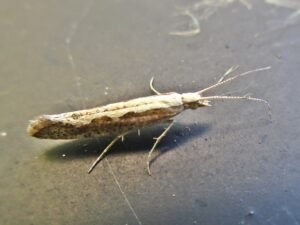
Its name comes from the distinctive diamond-shaped markings visible on the folded wings of adult moths.
Identification
Adult Moth
Adult diamondback moths are small, slender insects measuring approximately 8–10 mm in length. Their forewings are grayish-brown with cream-colored markings that form a series of diamond shapes when the wings are folded.
Eggs
Eggs are tiny, oval, yellowish-white, and usually deposited individually or in small groups on the underside of leaves.
Larvae
The larvae are light green and reach about 8–12 mm in length when fully grown. When disturbed, they often wriggle vigorously and may drop from the plant suspended by a silk thread.
Pupae
Pupation occurs inside a loose silk cocoon attached to leaves, stems, or plant debris.
Biology & Ecology
The diamondback moth has a remarkably short life cycle. Under warm conditions, development from egg to adult may take as little as 14–21 days, allowing multiple generations annually.[2]
Females can lay over 100 eggs during their lifetime, contributing to rapid population growth.
Larvae feed primarily on leaf tissue, creating characteristic feeding damage. Young larvae often mine inside leaves, while older larvae feed externally.
In practice, technicians and crop consultants frequently observe severe infestations developing within only a few weeks after the first moths appear. Fields that looked healthy during one inspection may show extensive leaf damage during the next visit if monitoring is neglected.
Unlike many agricultural pests, diamondback moths can migrate long distances with wind currents, helping them colonize new growing areas quickly.
Global Distribution
The diamondback moth is considered one of the most widely distributed insect pests in the world. It occurs on every continent except Antarctica and is found wherever crucifer crops are cultivated.[1]
Major infestations occur throughout:
- Europe
- North America
- South America
- Africa
- Asia
- Australia
- New Zealand
Because brassica vegetables are grown globally, the pest remains a constant challenge for commercial agriculture.
Risks / Damage
Direct Crop Damage
Larvae feed on leaves, reducing photosynthetic capacity and weakening plants.
Damage typically appears as:
- Small irregular holes in leaves
- "Windowpane" feeding where leaf surfaces remain partially intact
- Skeletonized foliage
- Contaminated harvested produce due to larval presence
Economic Impact
The diamondback moth is estimated to cause billions of dollars in crop losses and management costs globally each year.[3]
Marketability can be severely reduced even when feeding damage is relatively minor, especially in crops intended for fresh consumption.
A common mistake is relying solely on calendar-based pesticide applications. This approach often accelerates insecticide resistance while failing to control populations effectively.
Signs of Infestation
Early detection is critical for successful management.
Common signs of diamondback moth infestation include:
- Small feeding holes in leaves
- Green larvae on leaf undersides
- Silken threads hanging from disturbed larvae
- Window-like feeding patches
- Presence of small gray-brown moths flying around crops
- Silk cocoons attached to foliage
Most growers first notice damage on younger leaves and the outer portions of cabbage heads.
Control & Prevention Methods
Regular Monitoring
Field scouting should begin early in the growing season. Weekly inspections help identify infestations before economic damage occurs.
Pheromone traps are commonly used to monitor adult moth activity and population trends.
Cultural Controls
Effective cultural practices include:
- Crop rotation
- Removal of crop residues
- Destruction of volunteer brassica plants
- Weed management around production areas
- Use of insect exclusion netting where practical
Biological Control
Numerous natural enemies attack diamondback moth populations, including parasitic wasps such as Diadegma semiclausum and Cotesia plutellae.[2]
Conserving beneficial insects can significantly reduce pest pressure.
Growers interested in integrated pest management may also find it useful to compare management strategies used against cabbage loopers and imported cabbageworms, which often occur in the same crops.
Microbial Insecticides
Products containing Bacillus thuringiensis (Bt) remain important tools for diamondback moth management when applied correctly and rotated with other control methods.
Advanced / Professional Approaches
Integrated Pest Management (IPM)
The most effective long-term strategy is a comprehensive Integrated Pest Management program.
This typically combines:
- Scouting and monitoring
- Economic thresholds
- Biological controls
- Cultural practices
- Selective insecticides
- Resistance management programs
What most people don't realize is that diamondback moth populations can develop resistance faster than many other agricultural pests. Repeated use of the same active ingredient may render treatments ineffective within a relatively short period.
Resistance Management
Resistance has been documented against multiple insecticide classes worldwide.[3]
For this reason, professional crop protection programs rotate products with different modes of action and integrate non-chemical controls.
See our guide on cabbage pests for additional management recommendations. Growers may also benefit from reviewing information on cutworms and flea beetles, which frequently affect brassica crops.
FAQ Section
What crops does the diamondback moth attack?
It primarily attacks cruciferous crops such as cabbage, broccoli, cauliflower, kale, Brussels sprouts, mustard, and canola.
How do I identify diamondback moth larvae?
The larvae are small, green, tapered at both ends, and often drop from leaves on silk threads when disturbed.
Can diamondback moth infestations destroy an entire crop?
Severe infestations can significantly reduce yield and market quality, particularly when control measures are delayed.
How does the diamondback moth spread?
Adult moths can fly locally and may also migrate long distances with prevailing winds.
What is the best treatment for diamondback moth?
The best treatment combines monitoring, biological control, cultural practices, and selective insecticides within an IPM program.
Are organic control methods effective?
Yes. Biological insecticides containing Bacillus thuringiensis (Bt), along with beneficial insects and cultural controls, can provide effective management.
Why is diamondback moth difficult to control?
Its rapid reproduction, multiple annual generations, and ability to develop insecticide resistance make management challenging.
Final Thoughts
The diamondback moth remains one of the most important insect pests affecting brassica crops worldwide. Successful management depends on early detection, regular monitoring, integrated pest management practices, and resistance-aware treatment strategies. Growers who combine biological, cultural, and chemical controls generally achieve better long-term results than those relying on a single method.
Disclaimer
This article is for informational purposes only. Food safety (HACCP) and pest control requirements vary by country, authority, and type of food business. For legal compliance and audit readiness, always consult a qualified HACCP professional and a licensed pest control operator in your area.
All pest control measures must use approved products and be applied strictly according to the product label, as required by law in most jurisdictions (including the EU, UK, and USA). Improper use of pesticides, lack of documentation, or absence of a structured pest monitoring program may lead to non-compliance, fines, or business closure.
A compliant system must include documented procedures, monitoring records, corrective actions, and verification. Pest control is not optional—it is a core prerequisite program under HACCP and must be properly implemented, recorded, and reviewed.
Author Bio
BSc Agronomist & Certified Pest Control Expert
Scientific Director – Advance Services (Athens, Greece)
Licensed Pest Control Business – Ministry of Rural Development & Food (GR)