Drywood Termites: Identification, Risks, and Control
 If you're in Southern or Central Europe, the termite you're statistically most likely to encounter is the subterranean type — it lives underground and travels through soil tunnels to reach wood, which is exactly why so many people in these regions assume they "don't have termites": you rarely see one crawling around. In my own inspections, every case that initially looked like a drywood termite infestation ultimately turned out to involve subterranean termites.
Drywood termites are much less common than subterranean termites across most of Europe. Some species are native to Mediterranean regions, while others may be introduced through infested furniture, wooden crates, or reclaimed timber. Unlike subterranean termites, they do not require contact with soil, allowing colonies to survive entirely inside dry wood.
What makes drywood termites different
Drywood termites (family Kalotermitidae, genus Cryptotermes among others) live entirely inside the wood they feed on. They dig irregular tunnel networks with no openings to the outside, except the temporary ones cut during a swarm. The tunnels are partitioned with fecal material and lined with a fecal "plaster" — which is also where their most recognizable evidence comes from.
Subterranean termites (Reticulitermes spp., the dominant genus in Greece) need soil moisture and build mud tubes to bridge and go from ground to wood. Drywood termites skip that step entirely. That's the whole reason they're harder to predict: there's no visible tube leading anywhere, no soil connection to inspect. The entire colony, including the king and queen, lives inside the wood.
A known example of how specific this can get: Neotermes tectonae infests teak trees in Java — the same teak that ends up as imported wood flooring. Cryptotermes species bore into trees and furniture across many parts of the world and are the ones most often moved long distances inside seasoned wood and furniture, since they can survive extended dry periods without needing to return to soil.
How to tell it's a termite and not something else
Two mistakes happen constantly: confusing termites with flying ants, and not noticing drywood termites at all until the damage is advanced.
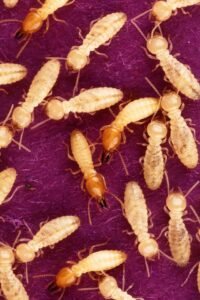
Flying ants vs. termites: On a winged ant, the front wings are longer than the hind wings, the antennae are elbowed, and the body has a distinct narrow waist. On a winged termite, both pairs of wings are nearly equal in length, the antennae are straight and bead-like, and the body appears broadly joined, without a visible waist. Depending on the species, winged termites range from pale brown to dark brown or black. Workers, in contrast, are pale, soft-bodied, and almost translucent.
Signs specific to drywood infestation:
Termite droppings (frass) — hard, six-sided pellets that look like fine sawdust or coffee grounds, usually found in small piles under a tiny exit hole. This is the most reliable sign of a drywood termite infestation and often the only visible one before significant damage occurs.
Kick-out holes — tiny openings where termites push the frass out of their tunnels inside the wood.
A hollow sound when you tap the wood, sometimes with a swollen or slightly cracked surface that may look like water damage.
Shed wings near windowsills or light fixtures after a swarm, usually on warm spring evenings, often after rain.
Because the colony never contacts the soil, the usual advice to inspect the foundation does not apply. Instead, inspect the wood itself: furniture, window frames, structural beams, and any other dry, untreated wood.
Why colonies go unnoticed for so long
A drywood colony is small compared to a subterranean one — typically a few thousand individuals rather than the hundreds of thousands a mature ground colony can reach. It grows slowly, stays active through winter (unlike subterranean colonies in temperate climates, which slow down or stop egg-laying in the cold months), and does its damage from the inside out. The first real sign most people get is when a finger or a screwdriver goes straight into wood that looked solid a moment earlier — by which point the gallery network inside has usually been established for a long time.
Control
Because the colony lives entirely inside the timber, surface treatment does very little. The options that actually reach the colony:
Inspection — sounding the wood, checking for frass and kick-out holes, and in more thorough inspections, moisture meters or borescopes to look inside voids without cutting the wood open.
Spot treatment — drilling into the infested gallery and injecting termiticide or foam directly where the colony is, rather than spraying the surface around it.
Fumigation — for infestations that have spread through more of the structure, whole-building tent fumigation is the method that reaches everything at once, including galleries that were never located during inspection.
Wood replacement — for timber that's already structurally compromised, treatment doesn't restore strength; the piece needs to come out.
Preventive wood treatment — imported or replacement timber can be treated with insecticide before installation, which is standard practice for wood coming from regions where drywood species are established.
Any termiticide application should only be carried out by a licensed pest control professional, following label instructions exactly — these products are regulated precisely because incorrect application creates a real health risk in an occupied building.
Reducing the risk
Since entry doesn't depend on soil contact, prevention here is mostly about the wood itself:
Seal or paint exposed wood surfaces rather than leaving raw timber outdoors or in storage.
Inspect secondhand furniture, reclaimed wood, and imported wooden items before bringing them inside — this is the actual entry route for drywood species in a region where they're not established in the local environment.
Keep an eye on structural timber periodically, not just when something looks wrong — frass pellets are easy to miss in a corner or behind furniture until there's a noticeable pile.
If you're dealing with visible termite activity of any kind in Greece, checking whether it's the subterranean type first is worth doing before assuming drywood — the treatment approach is different, and subterranean is by far the more common cause locally.
Disclaimer
This article is for informational purposes only. Pest control laws and approved chemicals vary by country. For best results and legal safety, we strongly recommend contacting a licensed pest control professional in your local area. Always make sure that the pest control technician is properly certified or licensed, depending on your country’s regulations. It’s important to confirm that they only use approved products and apply them exactly as instructed on the product label. In most places in Europe, UK, or USA, following label directions is not just best practice—it’s the law.
Author Bio
Nasos Iliopoulos, BSc Agronomist & Certified Pest Control Expert
Scientific Director – Advance Services (Athens, Greece)
Licensed Pest Control Business – Ministry of Rural Development & Food (GR)
Nasos specializes in structural pest control and integrated pest management. His focus is on practical, eco-friendly strategies that combine prevention, treatment, and long-term monitoring.
References
-
Pubmed Central - Termites live in a material world: exploration of their ability to differentiate between food sources
-
Wikipedia - Kalotermitidae