Hessian Fly
The Hessian Fly (Mayetiola destructor) is one of the most economically important insect pests of wheat worldwide. Despite its tiny size, this fly can cause severe yield losses by attacking young wheat plants and weakening stems before grain production begins. Infestations often go unnoticed until plants become stunted, lodge before harvest, or produce fewer and smaller grain heads.
For wheat growers, the Hessian Fly represents a persistent challenge because its larvae develop hidden inside the plant, making early detection difficult. Fortunately, combining resistant wheat varieties with proper crop management can greatly reduce its impact.
What is the Hessian Fly?
The Hessian Fly is a small gall midge belonging to the family Cecidomyiidae. It primarily attacks wheat but may also infest barley, rye, and several wild grasses. The insect is believed to have originated in southwestern Asia before spreading worldwide alongside wheat cultivation.
Unlike insects that chew leaves or bore into stems, Hessian Fly larvae feed by sucking nutrients from plant tissues at the base of stems, disrupting normal growth and weakening the plant.
Identification
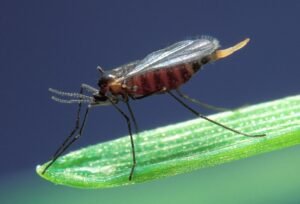
Adult Hessian Flies resemble tiny mosquitoes and measure only 3–4 mm long. They have slender dark bodies, long legs, and delicate wings. Adults live only a few days and do not feed.
Eggs are elongated, shiny red, and are laid in rows along the upper surface of wheat leaves.
Larvae are small, white maggots that gradually become greenish-white before developing into brown, seed-like pupae commonly called "flaxseeds" because of their resemblance to flax seeds.
These pupae are often the easiest stage to identify during crop inspections.
Biology & Ecology
Female flies lay eggs shortly after emerging from pupae. Newly hatched larvae crawl down the leaf toward the base of the plant, where they establish feeding sites between the stem and leaf sheath.
The larvae inject saliva that alters normal plant development while continuously feeding on plant sap. As a result, stems become weakened, tillering is reduced, and grain production declines.
Depending on local climate, several generations may occur each year. Pupae survive between crop seasons inside volunteer wheat, crop residues, or infested grasses.
In practice, technicians often discover infestations only after splitting stems and finding the characteristic brown flaxseed-like pupae hidden near the plant base. By then, much of the feeding damage has already occurred.
Global Distribution
The Hessian Fly is found throughout nearly every major wheat-producing region, including North America, Europe, North Africa, the Middle East, Asia, Australia, and parts of South America.
Its distribution closely follows commercial wheat production, with population levels varying according to climate, cropping practices, and the availability of susceptible wheat varieties.
Risks and Crop Damage
Larval feeding weakens wheat stems, reduces tiller development, decreases plant vigor, and significantly lowers grain yield.
Young plants may die completely following heavy infestations, while older plants often produce fewer grain heads or lodge before harvest because weakened stems cannot support developing grain.
Severe infestations can reduce wheat yields by more than 30%, with even greater losses occurring when environmental conditions favor repeated generations.
Signs of Hessian Fly Infestation
- Stunted wheat plants.
- Dark green, thickened leaves.
- Poor tiller development.
- Weak stems that lodge before harvest.
- Small grain heads.
- Brown flaxseed-like pupae near the stem base.
- Uneven crop growth across the field.
A common mistake is assuming lodging results only from wind or heavy rainfall. In many wheat fields, weakened stems caused by Hessian Fly larvae make plants far more susceptible to falling over during adverse weather.
Control and Prevention Methods
Resistant Wheat Varieties
Growing resistant cultivars remains one of the most effective methods of long-term Hessian Fly management.
Destroy Volunteer Wheat
Volunteer wheat serves as a bridge between growing seasons and allows populations to survive. Eliminating these plants reduces future infestations.
Crop Rotation
Rotating wheat with non-host crops interrupts the insect's life cycle and lowers population pressure.
Adjust Planting Dates
Delayed planting after the local "fly-free date" helps avoid peak adult emergence in many wheat-producing regions.
Field Sanitation
Managing crop residues and controlling grassy weeds reduce overwintering habitats.
Chemical Control
Foliar insecticides generally provide limited effectiveness because larvae remain protected inside plant tissues. Seed treatments may provide early-season protection where recommended by local agricultural authorities.
See our guide on Wheat Stem Sawfly for another important pest affecting cereal production.
Advanced Professional Approaches
Modern integrated pest management combines resistant varieties, regional monitoring programs, crop rotation, volunteer wheat control, and carefully selected planting dates. These combined strategies provide significantly better long-term suppression than relying on insecticides alone.
What most people don't realize is that the Hessian Fly spends almost its entire damaging stage hidden inside the plant. Once larvae are established beneath the leaf sheath, insecticide applications usually have little effect, making prevention far more valuable than treatment.
Frequently Asked Questions
What crops does the Hessian Fly attack?
It primarily attacks wheat but may also infest barley, rye, and certain wild grasses.
Are Hessian Flies harmful to humans?
No. They do not bite people or transmit diseases.
Why is it called the Hessian Fly?
The insect was historically believed to have arrived in North America with Hessian troops during the American Revolutionary War, although its exact introduction remains uncertain.
Can Hessian Fly infestations kill wheat?
Yes. Heavy infestations may kill seedlings or severely weaken mature plants, leading to substantial yield losses.
What is the best treatment for Hessian Fly?
Growing resistant varieties, eliminating volunteer wheat, rotating crops, and planting after the local fly-free date remain the most effective management strategies.
How do growers detect Hessian Fly?
Inspecting stems for the characteristic brown flaxseed-like pupae near the base of wheat plants provides one of the most reliable methods of diagnosis.
Final Thoughts
The Hessian Fly continues to be one of the most important pests affecting wheat production because its hidden larval feeding weakens plants long before visible symptoms appear. Early prevention through resistant cultivars, crop rotation, sanitation, and proper planting schedules offers the best protection against economic losses while supporting sustainable cereal production.
Learn more about Agricultural & Outdoor Pests
Disclaimer
This article is for informational purposes only. Food safety (HACCP) and pest control requirements vary by country, authority, and type of food business. For legal compliance and audit readiness, always consult a qualified HACCP professional and a licensed pest control operator in your area.
All pest control measures must use approved products and be applied strictly according to the product label, as required by law in most jurisdictions (including the EU, UK, and USA). Improper use of pesticides, lack of documentation, or absence of a structured pest monitoring program may lead to non-compliance, fines, or business closure.
A compliant system must include documented procedures, monitoring records, corrective actions, and verification. Pest control is not optional—it is a core prerequisite program under HACCP and must be properly implemented, recorded, and reviewed.
Author Bio
BSc Agronomist & Certified Pest Control Expert
Scientific Director – Advance Services (Athens, Greece)
Licensed Pest Control Business – Ministry of Rural Development & Food (GR)