House Centipedes Lifecycle: How Long Do They Live and Should You Worry?
If you've ever flicked on the bathroom light at night and seen something with way too many legs sprint across the tile, you've met a house centipede. People call them hairy centipedes because of the thin, fuzzy-looking legs and long antennae. They're fast, they're unsettling, and almost every homeowner asks me the same two questions: how long do house centipedes live, and do I actually have a problem?
House centipedes lifecycle is strange. Here's what I know from the field and from the biology behind it. This guide explains their lifespan, life cycle, behavior indoors and outdoors, and what it really means when you find one in your home.
Table of Contents
- What Exactly Is a House Centipede?
- How Long Do House Centipedes Live?
- The Life Cycle, Stage by Stage
- Do They Live Longer Indoors or Outdoors?
- What Keeps a House Centipede Alive That Long?
- What Temperature Kills a Centipede?
- Are House Centipedes Dangerous?
- Where Do They Hide?
- Do They Lay Eggs Indoors?
- "Hairy Centipede" vs. House Centipede
- How Do You Control Them?
- Should You Even Remove Them?
- FAQ
What exactly is a house centipede?
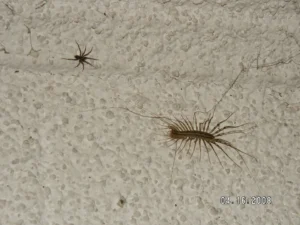
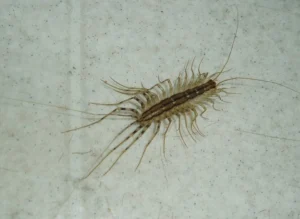 It is sometimes called the "hairy centipede" because its thin legs and long antennae make it look fuzzy or spidery.
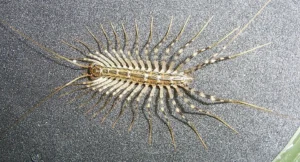
The house centipede (Scutigera coleoptrata) is the species you're dealing with in 95% of indoor sightings. Adults have 15 pairs of long legs, a yellow-gray body with darker longitudinal stripes, and grow to about 2.5–5 cm.
They move fast — close to half a meter per second — which is exactly why they're so hard to catch and why they trigger such a strong reaction from people. Unlike cockroaches or ants, they're not after your food, your pantry, or your clothes. They're predators. They hunt other insects and spiders living in your house, which is why some people call them "free pest control." I understand the logic, but most clients still don't want to share a bathroom with one.
Originally from the Mediterranean, house centipedes are now established across North America, Europe, Asia, and parts of Australia. They do well indoors because a house gives them exactly what they need: stable humidity, stable temperature, and a steady supply of prey.
How long do house centipedes live on average?
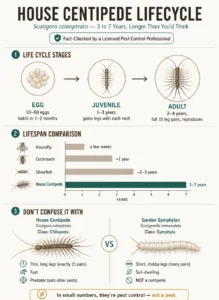
 This is the part that surprises most people. A house centipede can live 3 to 7 years — long for a household insect. For comparison, a housefly lives weeks, and a cockroach usually doesn't make it past a year.
Indoors, they tend to live longer than outdoors, since they're sheltered from freezing winters, heat stress, and predators. If you're seeing one regularly in the same part of the house, it may genuinely be the same individual you've been seeing for a couple of years.
The life cycle, stage by stage
Eggs — A female lays 10–60 eggs in damp cracks or soil. These hatch in roughly 1–2 months.
Juveniles — They hatch with fewer legs and add legs and segments with each molt. This stage can last 1–3 years depending on conditions.
Adults — Once they reach the full 15 leg pairs, they're sexually mature and can live another 2–4 years.
Add it up and you get the 3–7 year range. Very few common household pests come close — silverfish are the only real comparison, and even they usually fall short.
Do they live longer indoors or outdoors?
 Indoors, conditions are close to ideal: stable temperature, no freezing, no dehydration risk, and far fewer predators. Bathrooms, basements, and laundry rooms tend to have the humidity they need, and if the house has a supply of small insects — spiders, ants, silverfish, cockroaches — they have everything required to reach the top of their lifespan, sometimes 5+ years.
Outdoors is a different story. Dry conditions dehydrate them quickly, and they're exposed to birds, lizards, and larger centipedes that prey on them. Most outdoor individuals never get close to their maximum lifespan — which is a big part of why, once one finds its way indoors, it tends to stay.
It's worth being precise here, because I see this confused a lot: the garden symphylan (Scutigerella immaculata) is often mislabeled online as a "garden centipede." It isn't a centipede at all — it belongs to a completely different class (Symphyla, not Chilopoda), and it's a root-feeding agricultural pest, not a predator. It doesn't compete with house centipedes and it essentially never turns up indoors. If you want the full picture on that one, see our dedicated garden centipede article.
Stone centipedes (order Lithobiomorpha) are a genuine outdoor centipede relative — shorter-bodied, fast, living under rocks and leaf litter. They almost never establish indoors the way Scutigera coleoptrata does.
What keeps a house centipede alive that long?
Four things, in order of importance:
- Moisture. They lose water fast through their exoskeleton, so they need humid microclimates — bathrooms, basements, crawl spaces.
- Food supply. They hunt cockroaches, silverfish, ants, small spiders, even termites. A house with an active insect population can support centipedes for years.
- Shelter. Wall voids, baseboard gaps, under sinks — dark, undisturbed spots.
- Stable temperature. No seasonal extremes to survive.
Get all four in place and you're looking at the top end of the lifespan — 6 to 7 years.
What temperature kills a centipede?
Prolonged exposure below freezing (around 0°C / 32°F) or sustained heat above roughly 40–45°C (104–113°F) is lethal, depending on the species. In practice, they avoid both extremes by staying in protected, buffered environments — which is exactly why they gravitate toward the inside of a house rather than an exposed exterior wall.
Are house centipedes dangerous?
No, not in any meaningful sense.
- Bites happen, but rarely, and feel roughly like a mild bee sting.
- Allergic reactions are possible in sensitive individuals — some redness or swelling, occasionally a stronger reaction, but this is uncommon.
- Venom is there to immobilize prey insects. It's not potent enough to be a real threat to a person.
- Disease transmission — none documented.
If anything, they're doing you a small favor by eating other pests. That said, "harmless" and "welcome in your bathroom" are two different things, and I get why most people don't want either.
Where do they hide?
They're nocturnal and light-averse. Typical spots:
- Bathrooms — under sinks, behind toilets, inside wall cracks near drains
- Basements — corners, storage boxes, crawl spaces
- Kitchens — behind appliances, under cupboards where moisture collects
- Wall voids — around pipes, vents, electrical conduits
- Closets/storage — under clothing piles or cardboard
If you see one out in the open, it's because it got flushed out mid-hunt or startled by a light coming on — not because it wants to be seen.
Do they lay eggs indoors?
Yes, if conditions allow it. Females look for the same damp, hidden spots — basement soil, cracks, gaps behind baseboards — and lay 10–60 eggs per clutch, hatching in 1–2 months.
One myth worth killing: house centipedes do not breed like cockroaches. Reproduction is slow, and populations stay small. Seeing one or two is not evidence of an infestation. If you're seeing several regularly, it usually means the house is supporting a healthy population of other insects that the centipedes are feeding on — the centipede is a symptom, not the root cause.
"Hairy centipede" vs. house centipede — same thing?
Yes. "Hairy centipede" is just a common nickname for Scutigera coleoptrata, driven by the fuzzy-looking legs and antennae. Same species, same 3–7 year lifespan.
Don't confuse it with Scolopendra species — thicker-bodied, shorter-legged, and capable of a more painful bite. Those are almost never an indoor problem. If what you're seeing indoors is thin-legged and fast, it's the house centipede, not Scolopendra.
How do you control them?
Reduce the conditions that support them
- Run a dehumidifier in basements and bathrooms; fix leaks
- Seal cracks, gaps around pipes, and damaged screens
- Declutter storage areas and pull boxes/furniture away from walls
- Diatomaceous earth along baseboards and dark corners can help as a passive control
Monitor
- Sticky traps under sinks, behind toilets, and in corners give you a real read on activity levels before you decide whether action is even needed
Chemical control
- For larger populations, residual sprays or dusts applied to baseboards, corners, and wall voids can help — always per label instructions. In most jurisdictions, professional-grade products are restricted to licensed applicators, and for good reason.
Should you even remove them?
Depends on your tolerance, honestly.
Case for leaving them alone: they eat cockroaches, ants, spiders, even bed bugs and termites in some cases. They don't damage structures or food. In small numbers, they're a net positive.
Case for removing them: they're startling, fast, and can bite if handled. For anyone with sensitivities, that's a real consideration.
My take: in low numbers, they're more helpful than harmful. If you genuinely can't tolerate seeing one, focus on exclusion and moisture control rather than chemical overkill — you're treating a symptom of a bigger insect population, not a centipede problem specifically.
Bottom line
House centipedes live far longer than almost any other pest you'll find indoors — up to 7 years under the right conditions. They're not dangerous, and they're actually doing some pest control of their own. If they bother you, go after humidity and entry points rather than the centipede itself. One sighting in the bathroom is not an infestation.
FAQ
Do house centipedes get in beds? Rarely. They prefer walls and floors, but in a humid room one might cross a bed while hunting.
Can they climb walls and ceilings? Yes — their legs and claws let them climb easily, which is why you'll occasionally spot one on a ceiling.
Are they common in apartments? Yes, particularly older buildings, ground floors, and units with leaking pipes or poor ventilation.
Do they die after mating? No. They mate and reproduce repeatedly across their multi-year lifespan.
Why are they called "hairy"? Because of the thin, fuzz-like appearance of the legs and antennae — not actual hair.
For more on indoor pests like this one, see our full Urban & Indoor Pests guide.
Sources
- Penn State Extension – house centipedes as predators, proofing advice: House Centipedes
- University of Kentucky (Entomology) – indoor survival, habitat: entomology.ca.uky.edu
- UGA Extension – long-lived centipedes, indoor reproduction, up to 6 years: Millipedes and Centipedes
- StatPearls (NCBI) – centipede envenomation, clinical significance: Centipede Envenomation
- Healthline – centipede bites rarely dangerous, mild symptoms: Identifying and Treating a Centipede Bite
Disclaimer
This article is for informational purposes only. Pest control laws and approved chemicals vary by country. For best results and legal safety, we strongly recommend contacting a licensed pest control professional in your local area. Always make sure that the pest control technician is properly certified or licensed, depending on your country's regulations. It's important to confirm that they only use approved products and apply them exactly as instructed on the product label. In most places in Europe, UK, or USA, following label directions is not just best practice—it's the law.
Author
Nasos Iliopoulos
BSc Agronomist & Certified Pest Control Expert
Scientific Director, Advance Services (Athens, Greece)
Licensed Pest Control Business – Ministry of Rural Development & Food (GR)