Japanese Beetle
Japanese Beetle 
The Japanese beetle (Popillia japonica) is one of the most destructive invasive insect pests affecting gardens, ornamental landscapes, fruit crops, and turfgrass. Originally native to Japan, this beetle has become a major agricultural and landscape pest in North America and continues to spread into new regions. Adult beetles feed on the leaves, flowers, and fruits of more than 300 plant species, while their larvae attack grass roots beneath the soil.
For homeowners, gardeners, and farmers, understanding how to identify Japanese beetles early and implementing effective management strategies can significantly reduce plant damage. In practice, most infestations begin with only a few beetles, but because adults release aggregation pheromones, dozens or even hundreds may quickly gather on the same plant.
What is a Japanese beetle?
The Japanese beetle is an invasive scarab beetle that feeds on hundreds of ornamental and agricultural plants. Adults skeletonize leaves by eating the tissue between the veins, while underground grubs feed on turfgrass roots, weakening lawns. Early detection and integrated pest management are the most effective ways to reduce damage.
Identification: How to Recognize Japanese Beetles
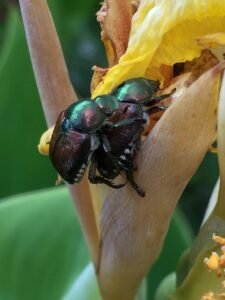
Adult Japanese beetles are approximately 8–11 mm (about ½ inch) long with a distinctive metallic green head and thorax combined with shiny copper-colored wing covers. One of their most recognizable features is the row of small white hair tufts along each side of the abdomen and two additional tufts at the rear.
The larvae, commonly called white grubs, are creamy white with brown heads and are typically found curled into a characteristic C-shape beneath lawns and grassy areas.
If you are uncertain whether you have Japanese beetles, compare them with other scarab beetles or see our guide on May beetles and June beetles for identification differences.
Biology & Ecology
Japanese beetles generally complete one generation per year in most temperate regions. Adult emergence usually begins in early summer and continues for several weeks. Females repeatedly lay eggs in moist soil, particularly in irrigated lawns, golf courses, parks, and pastures.
Eggs hatch into grubs that feed on grass roots throughout late summer before moving deeper into the soil for winter. Feeding resumes in spring before the larvae pupate and emerge as adults.
Adults are active during warm, sunny days and readily fly between host plants. They are attracted not only by plant odors but also by pheromones released by other feeding beetles, which explains why heavy infestations often appear suddenly.
What most people don't realize is that the first beetles arriving on a plant usually cause only limited damage. However, their feeding attracts many more beetles, leading to rapid defoliation within just a few days.
Global Distribution
The Japanese beetle is native to Japan, where natural predators help regulate its populations. Outside its native range, it has become established in large parts of the United States and Canada and has recently been detected in several European countries, where eradication and containment programs are ongoing.
International trade involving nursery plants, soil, and turf products has contributed to its spread. Many countries maintain strict quarantine measures to prevent accidental introductions.
Risks and Damage
Japanese beetles attack more than 300 species of plants, including:
- Roses
- Grapes
- Apples
- Peaches
- Cherries
- Plums
- Linden trees
- Maples
- Birch
- Beans
- Corn
- Soybeans
Adults typically feed between leaf veins, creating a lace-like or "skeletonized" appearance. Severe infestations may completely strip foliage, reduce flowering, damage fruit quality, and weaken trees and shrubs.
The underground grubs feed on grass roots, causing turf to become thin, brown, and easily pulled from the soil. Damaged lawns also attract wildlife such as skunks, raccoons, and birds searching for grubs.
Unlike termites or carpenter ants, Japanese beetles do not damage buildings, but their impact on landscapes and agriculture can be economically significant.
In practice, technicians often find that homeowners notice the leaf damage long before they realize grubs are already developing beneath the lawn. By the time brown patches appear, the larvae may already be well established.
Signs of Japanese Beetle Infestation
Common signs include:
- Leaves with only veins remaining.
- Clusters of metallic green beetles feeding together.
- Damaged flowers and fruit.
- Brown patches developing in lawns.
- Grass lifting easily due to destroyed roots.
- Increased activity of birds or mammals digging into turf.
Control and Prevention Methods
The best treatment for Japanese beetles combines monitoring, cultural practices, biological control, and targeted insecticide applications when necessary.
Hand Removal
For small gardens, collecting beetles by hand during the early morning can significantly reduce populations before they attract additional beetles.
Healthy Lawn Management
Avoid excessive irrigation during the egg-laying period when practical. Healthy, deep-rooted turf can tolerate moderate grub feeding better than stressed lawns.
Biological Control
Beneficial nematodes and bacterial products containing Bacillus popilliae or Bacillus thuringiensis strains used for grub management may help suppress larval populations under suitable conditions.
Chemical Control
Residual insecticides may be used against adults when populations exceed acceptable levels. Preventive or curative grub treatments are generally most effective when applied according to label directions during the early larval stages.
All pesticide applications should follow local regulations and product label instructions.
A common mistake is relying entirely on pheromone traps placed near valuable plants. Although traps capture many beetles, they may also attract even more beetles into the surrounding area if positioned incorrectly.
Advanced Professional Approaches
Professional pest management programs rely on Integrated Pest Management (IPM), combining regular monitoring, plant inspections, biological controls, and carefully timed treatments rather than routine spraying.
Commercial growers often monitor adult emergence using degree-day models and field scouting before deciding whether intervention is economically justified.
Where infestations become severe, professionals may combine grub management with adult suppression to reduce future populations while minimizing unnecessary pesticide use.
Frequently Asked Questions
Are Japanese beetles dangerous to humans?
No. They do not bite, sting, or transmit diseases to people.
Can Japanese beetles kill trees?
Healthy mature trees usually survive, but repeated heavy defoliation can weaken them over time.
Do Japanese beetles damage lawns?
Adult beetles feed on plants, but their grubs damage lawns by feeding on grass roots.
What plants do Japanese beetles prefer?
They commonly attack roses, grapes, apples, cherries, peaches, beans, lindens, and many ornamental shrubs.
When are Japanese beetles most active?
Adults are generally most active during warm summer days from late June through August, depending on local climate.
What is the best treatment for Japanese beetles?
An integrated approach combining monitoring, cultural practices, biological control, and properly timed insecticide applications provides the most reliable long-term management.
Final Thoughts
Japanese beetles remain one of the most challenging invasive pests for homeowners, landscapers, and agricultural producers. Fortunately, early identification and integrated pest management can greatly reduce their impact. Monitoring plants regularly, protecting lawns from grub damage, and using targeted treatments only when necessary provides the best balance between effective control and environmental responsibility.
Disclaimer
This article is for informational purposes only. Food safety (HACCP) and pest control requirements vary by country, authority, and type of food business. For legal compliance and audit readiness, always consult a qualified HACCP professional and a licensed pest control operator in your area.
All pest control measures must use approved products and be applied strictly according to the product label, as required by law in most jurisdictions (including the EU, UK, and USA). Improper use of pesticides, lack of documentation, or absence of a structured pest monitoring program may lead to non-compliance, fines, or business closure.
A compliant system must include documented procedures, monitoring records, corrective actions, and verification. Pest control is not optional—it is a core prerequisite program under HACCP and must be properly implemented, recorded, and reviewed.
Author Bio
BSc Agronomist & Certified Pest Control Expert
Scientific Director – Advance Services (Athens, Greece)
Licensed Pest Control Business – Ministry of Rural Development & Food (GR)