Mexican Bean Beetle
The Mexican Bean Beetle (Epilachna varivestis) is one of the most destructive pests of beans in North America and several other bean-growing regions. Although it belongs to the lady beetle family, unlike most ladybugs that feed on aphids and other pests, the Mexican Bean Beetle is a plant feeder. Both adults and larvae consume bean foliage, causing extensive leaf damage that can significantly reduce crop quality and yield.
Most gardeners associate lady beetles with beneficial insects, making the Mexican Bean Beetle particularly deceptive. Understanding how to identify this pest early is essential because heavy infestations can rapidly defoliate bean plants during the growing season.
What is the Mexican Bean Beetle?
The Mexican Bean Beetle is a herbivorous lady beetle native to Mexico that has become an important agricultural pest in many parts of North America. It primarily attacks beans (Phaseolus spp.) but may also feed on soybeans, cowpeas, lima beans, and other legumes when preferred hosts are unavailable.
Unlike beneficial lady beetles that prey on soft-bodied insects, the Mexican Bean Beetle feeds directly on plant tissue throughout both its larval and adult stages.
Identification
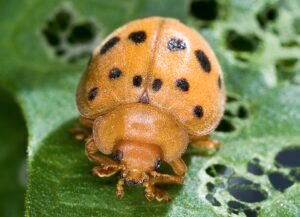
Adult Mexican Bean Beetles are approximately 6–8 mm long with a rounded, dome-shaped body. Their color ranges from copper-yellow to orange-brown and they usually have sixteen black spots arranged across their wing covers.
Larvae look completely different from adults. They are bright yellow to orange with numerous branched spines covering their bodies, giving them a fuzzy or prickly appearance. Eggs are yellow and are laid in clusters on the underside of leaves.
The pupal stage remains attached to foliage before emerging as an adult beetle.
Biology & Ecology
Adult beetles overwinter beneath crop debris, leaf litter, and protected vegetation before emerging in spring. Females begin laying eggs shortly after feeding on host plants.
Eggs hatch within one to two weeks depending on temperature. Larvae feed aggressively for several weeks before pupating on the leaves. Adults emerge shortly afterward and continue feeding while producing additional generations during warm seasons.
In warmer climates, several generations may develop annually, allowing populations to increase rapidly if left unmanaged.
In practice, technicians often observe that early infestations begin along field edges before gradually spreading throughout the crop. Regular scouting during the first weeks of plant growth makes control much easier than waiting until severe defoliation becomes visible.
Global Distribution
The Mexican Bean Beetle is widely distributed across the United States, southern Canada, Mexico, and parts of Central America. It occurs mainly where beans are grown commercially or in home gardens.
Although its economic importance varies with climate and local farming practices, it remains one of the most significant insect pests affecting edible beans in North America.
Risks and Crop Damage
Both adults and larvae feed on the underside of leaves, removing soft tissue between leaf veins and creating a characteristic "skeletonized" appearance.
Heavy infestations reduce photosynthesis, weaken plants, delay pod development, and decrease bean production. Severe defoliation may expose pods to excessive sunlight, increasing quality losses.
Young seedlings are particularly vulnerable because they possess limited foliage and recover slowly after feeding damage.
Unlike many chewing insects that attack only one life stage, the Mexican Bean Beetle causes continuous feeding injury throughout most of its life cycle.
Signs of Mexican Bean Beetle Infestation
- Skeletonized leaves.
- Yellow egg clusters beneath foliage.
- Spiny yellow larvae feeding on leaves.
- Orange adult beetles with sixteen black spots.
- Premature leaf drop.
- Reduced flowering and pod production.
- General decline in plant vigor.
A common mistake is confusing Mexican Bean Beetles with beneficial ladybugs and avoiding treatment altogether. While most lady beetles help control pests, this species feeds directly on crops and can become highly destructive.
Control and Prevention Methods
Regular Monitoring
Inspect bean plants weekly, especially the undersides of leaves where eggs and larvae are commonly found.
Hand Removal
Small garden infestations can often be managed by removing egg masses, larvae, and adult beetles by hand.
Crop Rotation
Rotating bean crops reduces overwintering populations and interrupts the pest's life cycle.
Field Sanitation
Removing crop residues after harvest helps eliminate overwintering shelters and reduces spring populations.
Biological Control
Natural enemies such as the parasitic wasp Pediobius foveolatus, predatory insects, birds, and spiders contribute to population suppression in integrated pest management programs.
Chemical Control
When infestations exceed economic thresholds, registered insecticides may be applied according to local regulations and label instructions. Treatments are generally most effective against young larvae before severe defoliation develops.
See our guide on Bean Aphids for another common pest affecting bean production and integrated crop management.
Advanced Professional Approaches
Commercial growers often combine field scouting, economic thresholds, resistant varieties where available, biological control, and selective insecticide applications to minimize unnecessary pesticide use while maintaining profitable yields.
What most people don't realize is that larvae usually cause more feeding damage than adults. Controlling young larval populations early often produces better long-term results than targeting adults after heavy defoliation has already occurred.
Frequently Asked Questions
Is the Mexican Bean Beetle a true ladybug?
Yes. It belongs to the lady beetle family, but unlike most ladybugs, it feeds on plants rather than insects.
What crops does it attack?
It primarily attacks beans but may also feed on soybeans, cowpeas, lima beans, and other legumes.
Can Mexican Bean Beetles kill bean plants?
Heavy infestations can severely weaken or destroy young plants through extensive defoliation.
Are they harmful to humans?
No. They do not bite people or transmit diseases.
How do I get rid of Mexican Bean Beetles?
Early monitoring, hand removal, crop rotation, biological control, sanitation, and targeted insecticide applications when necessary provide the most effective management.
When are infestations most common?
Populations usually increase during late spring and summer as successive generations develop on bean crops.
Final Thoughts
The Mexican Bean Beetle remains one of the most important pests of beans because both larvae and adults feed directly on foliage throughout the growing season. Early identification, routine crop monitoring, and integrated pest management provide the most effective long-term protection while reducing unnecessary pesticide use. Recognizing this unusual plant-feeding lady beetle before populations explode can make the difference between a healthy bean harvest and significant crop losses.
Learn more about Agricultural & Outdoor Pests
Disclaimer
This article is for informational purposes only. Food safety (HACCP) and pest control requirements vary by country, authority, and type of food business. For legal compliance and audit readiness, always consult a qualified HACCP professional and a licensed pest control operator in your area.
All pest control measures must use approved products and be applied strictly according to the product label, as required by law in most jurisdictions (including the EU, UK, and USA). Improper use of pesticides, lack of documentation, or absence of a structured pest monitoring program may lead to non-compliance, fines, or business closure.
A compliant system must include documented procedures, monitoring records, corrective actions, and verification. Pest control is not optional—it is a core prerequisite program under HACCP and must be properly implemented, recorded, and reviewed.
Author Bio
BSc Agronomist & Certified Pest Control Expert
Scientific Director – Advance Services (Athens, Greece)
Licensed Pest Control Business – Ministry of Rural Development & Food (GR)