Rice Water Weevil
Lissorhoptrus oryzophilus, commonly known as the rice water weevil, is one of the most economically important insect pests of rice worldwide. Native to North America, this aquatic weevil has spread to several rice-producing regions across Asia and Europe, where it threatens crop productivity. Although adult feeding causes relatively minor injury, the larvae attack rice roots beneath flooded fields, reducing plant vigor, limiting nutrient uptake, and significantly lowering grain yields. Early detection and integrated pest management are essential for successful control.
What is the rice water weevil?
The rice water weevil (Lissorhoptrus oryzophilus) is a small beetle belonging to the family Curculionidae. Adults feed on rice leaves, while the larvae develop underwater and feed on plant roots. Larval feeding is responsible for most of the economic damage associated with this pest.
Identification of Rice Water Weevils
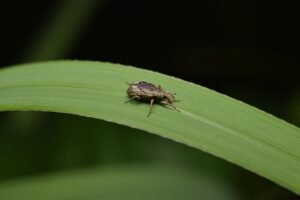
Adult rice water weevils are small beetles measuring approximately 3–4 mm long. Their elongated snout and grayish-brown coloration make them typical members of the weevil family.
Key identification features include:
- Gray to brown elongated body.
- Distinct curved snout (rostrum).
- Fine scales covering the body.
- Small dark spots on the wing covers.
- Cream-colored legless larvae with brown heads.
Adults are commonly found on rice foliage, while larvae remain submerged in flooded soil feeding directly on rice roots.
Biology & Ecology
The rice water weevil has a close relationship with flooded rice production. Adults overwinter in grasses, leaf litter, and field margins before moving into rice fields during spring.
After permanent flooding begins, females lay eggs inside leaf sheaths just below the waterline.
The life cycle consists of:
- Egg
- Four larval stages
- Pupa
- Adult
After hatching, larvae migrate into the soil where they feed on rice roots. Pupation occurs in small mud cells attached to the root system before adults emerge and continue feeding.
Depending on climate, one to two generations occur annually.
Global Distribution
Lissorhoptrus oryzophilus has expanded well beyond its native range and is now established in several major rice-producing countries.
Its distribution includes:
- United States
- China
- Japan
- South Korea
- Taiwan
- Italy
- France
- Other rice-growing regions of Europe and Asia
The movement of infested plant material and agricultural equipment has contributed to its spread.
Risks and Damage Caused by Rice Water Weevils
Adult feeding produces narrow longitudinal scars on rice leaves, but these injuries usually have little economic importance.
Most damage results from larval feeding on the root system.
Common effects include:
- Pruned and damaged roots.
- Reduced water and nutrient uptake.
- Stunted plant growth.
- Delayed tillering.
- Reduced plant vigor.
- Poor grain filling.
- Lower grain yield.
Young rice plants are particularly vulnerable because damaged roots cannot support normal development during the early growth stages.
In practice, growers often suspect fertilizer deficiencies when rice plants remain pale and stunted after flooding. Root inspections frequently reveal numerous rice water weevil larvae feeding below the soil surface, where damage remains hidden until crop growth begins to decline.
Signs of Rice Water Weevil Infestation
Early monitoring is essential for minimizing yield losses.
Typical signs include:
- Long feeding scars on leaves.
- Poor plant vigor.
- Reduced tillering.
- Yellowing plants.
- Damaged root systems.
- Cream-colored larvae attached to roots.
- Stunted crop growth after flooding.
Sampling roots several weeks after flooding provides one of the most reliable methods for detecting larval populations.
How to Get Rid of Rice Water Weevils
Effective management relies on Integrated Pest Management (IPM), combining cultural practices, monitoring, resistant varieties where available, and carefully timed insecticide applications.
Field Monitoring
Inspect adult activity before flooding and sample roots for larvae after permanent flooding has been established.
Water Management
Proper timing of flooding can influence egg laying and larval survival. Temporary drainage may reduce larval populations in some production systems.
Crop Rotation
Where practical, crop rotation and good field sanitation help reduce overwintering populations.
Biological Control
Predatory insects, spiders, parasitic nematodes, and naturally occurring pathogens contribute to population suppression, although biological control alone rarely provides complete protection under heavy infestations.
Chemical Control
Seed treatments and registered insecticides remain important management tools in regions with consistent economic damage. Applications should follow local recommendations and target the most susceptible stages of the pest.
A common mistake is delaying field inspections until obvious plant symptoms appear. By this stage, larvae may have already caused significant root damage that cannot be reversed during the current growing season.
Advanced Professional Approaches
Commercial rice producers increasingly integrate predictive models, field scouting, and economic thresholds into their management programs instead of relying solely on preventive insecticide applications.
Modern IPM programs combine resistant cultivars where available, precise water management, and regular root sampling to optimize treatment decisions while reducing unnecessary pesticide use.
What most people don't realize is that adult feeding scars often appear more dramatic than the actual economic damage. It is the hidden larval feeding beneath the flooded soil that determines whether yield losses become significant.
Rice growers should also monitor for other important rice pests such as rice stem borers, rice leaf folders, rice planthoppers, and rice bugs, since multiple pest species often occur simultaneously throughout the growing season.
Frequently Asked Questions
Are rice water weevils harmful to humans?
No. Rice water weevils feed only on rice and related grasses and do not bite humans or animals.
Which crops are attacked by rice water weevils?
Rice is their primary host, although some wild grasses may also support limited development.
Which life stage causes the greatest damage?
The larvae feeding on rice roots are responsible for most economic losses.
When are rice water weevils most active?
Adults invade rice fields shortly after flooding, while larvae develop beneath the soil during the early vegetative growth stages.
Can biological control eliminate rice water weevils?
Natural enemies help suppress populations, but integrated pest management is generally required for reliable economic control.
Should every infestation be treated with insecticides?
No. Treatment decisions should be based on monitoring results, larval densities, crop stage, and local economic thresholds.
Final Thoughts
The rice water weevil remains one of the most damaging insect pests of flooded rice production worldwide. Because the most destructive stage develops hidden beneath the soil surface, successful management depends on early monitoring, careful water management, regular root inspections, and integrated pest management strategies. Farmers who combine cultural practices with timely interventions can greatly reduce crop losses while promoting more sustainable rice production.
Learn more about Agricultural & Outdoor Pests
Disclaimer
This article is for informational purposes only. Food safety (HACCP) and pest control requirements vary by country, authority, and type of food business. For legal compliance and audit readiness, always consult a qualified HACCP professional and a licensed pest control operator in your area.
All pest control measures must use approved products and be applied strictly according to the product label, as required by law in most jurisdictions (including the EU, UK, and USA). Improper use of pesticides, lack of documentation, or absence of a structured pest monitoring program may lead to non-compliance, fines, or business closure.
A compliant system must include documented procedures, monitoring records, corrective actions, and verification. Pest control is not optional—it is a core prerequisite program under HACCP and must be properly implemented, recorded, and reviewed.
Author Bio
BSc Agronomist & Certified Pest Control Expert
Scientific Director – Advance Services (Athens, Greece)
Licensed Pest Control Business – Ministry of Rural Development & Food (GR)