Scale Insects (Coccoidea): Identification, Control, and Prevention
 Scale insects are among the most stubborn plant pests in both residential and commercial settings. These small, sap-sucking insects may look harmless at first glance—often mistaken for simple plant spots—but they can cause serious damage if left untreated.
Whether you’re growing indoor ornamentals, citrus trees, or greenhouse crops, scale infestations can quickly lead to yellowing leaves, stunted growth, and even plant death. I’ve seen entire rows of olive trees or ficus plants collapse just because the early signs were ignored.
In this article, I’ll explain how to identify scale insects, understand their biology, recognize infestation symptoms, and manage them effectively using both DIY and professional pest control methods.
Identification
Scale insects belong to the superfamily Coccoidea and include over 8,000 known species worldwide. They vary in color, shape, and size but share a common trait: a waxy or hard outer shell that protects them from many insecticides.
There are two main types:
-
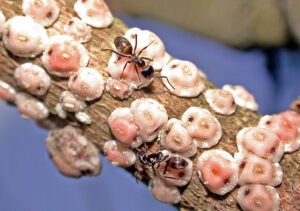
Soft scales (Coccidae) – like Coccus hesperidum (brown soft scale) and Saissetia oleae (olive scale). They excrete honeydew, a sticky substance that attracts ants and leads to sooty mold growth.
-
Armored scales (Diaspididae) – such as Aspidiotus nerii (oleander scale) and Aonidiella aurantii (California red scale). These have a tough shield that makes them harder to kill.
Identification tips:
-
Adults appear as small, round, or oval bumps on leaves, stems, or fruit.
-
Most species are immobile in the adult stage.
-
Nymphs (called crawlers) are tiny, yellowish, and mobile for a short time before settling to feed.
-
A sticky residue on leaves or black mold often indicates an active scale population.
Biology and Ecology
Understanding their life cycle is key to breaking it. Scale insects go through several stages: egg, crawler (nymph), and adult.
-
Eggs are laid under the female’s protective cover. Depending on the species, a single female can produce hundreds.
-
Crawlers are the only mobile stage and spread to new feeding sites. They are the most vulnerable to treatment.
-
Adults become stationary, forming their characteristic hard or waxy covering while feeding on plant sap.
Scale insects thrive in warm, dry environments and are often found on the underside of leaves or along stems. Overcrowded plantings, dusty leaves, and excess nitrogen fertilizer favor their spread.
Global Distribution
Scale insects are found worldwide, from the Mediterranean to Asia, North America, and Australia.
In tropical and subtropical climates, they reproduce year-round. In temperate zones, populations peak in summer and early autumn.
Commercial crops like citrus, olives, grapes, and coffee are particularly vulnerable. Indoor plants such as orchids, ficus, and succulents are frequent hosts in households.
Scale infestations have caused major agricultural losses in regions like:
-
California – Aonidiella aurantii on citrus.
-
Spain and Italy – Saissetia oleae in olive groves.
-
Southeast Asia – Unaspis citri on tropical fruit trees.
Risks and Damage
Scale insects feed by inserting needle-like mouthparts into plant tissue and sucking sap. This weakens the plant and causes:
-
Yellowing or curling of leaves.
-
Premature leaf drop.
-
Poor flowering or fruiting.
-
Stunted growth and dieback.
The honeydew excreted by soft scales encourages black sooty mold, which reduces photosynthesis. It also attracts ants, creating a symbiotic relationship that protects the scales from predators.
In agriculture, scale infestations can lead to:
-
Loss of marketable fruit due to blemishes.
-
Reduced yield and plant lifespan.
-
Increased costs for pesticide applications and labor.
Signs of Infestation
Common indicators include:
-
Sticky residue on leaves or surfaces below the plant.
-
Black mold coating leaves.
-
Bumps or crusty spots on stems and leaves that don’t brush off easily.
-
Presence of ants climbing the plant (feeding on honeydew).
-
Reduced plant vigor or leaf drop.
Inspect both sides of leaves with a magnifying glass, as scales often hide in sheltered areas.
Control Methods
1. Cultural Control
-
Prune infested branches and destroy them immediately.
-
Avoid over-fertilization, especially with nitrogen, which promotes soft tissue growth favored by scales.
-
Keep plants clean by wiping leaves regularly.
-
Encourage airflow and sunlight to reduce humidity.
2. Mechanical Control
-
Gently scrub off visible scales with a soft brush or cloth dipped in soapy water or alcohol.
-
Rinse plants thoroughly after treatment to avoid leaf burn.
3. Biological Control
Nature provides many helpers against scales:
-
Lady beetles (Chilocorus spp., Cryptolaemus montrouzieri).
-
Parasitic wasps (Aphytis melinus, Encarsia spp.).
-
Predatory mites and lacewings also contribute to population control.
Releasing or conserving these beneficials is an eco-friendly, sustainable option for greenhouses and gardens.
4. Chemical Control
For heavy infestations:
-
Use horticultural oils or neem oil to suffocate crawlers and exposed adults.
-
Apply systemic insecticides only under professional supervision.
-
Always treat during the crawler stage for best effectiveness.
Advanced Approaches
Integrated Pest Management (IPM)
I often use IPM strategies combining prevention, monitoring, and targeted control. For scales, this means:
-
Sticky traps to detect crawlers.
-
Regular plant inspections.
-
Spot treatments rather than blanket spraying.
-
Protecting beneficial insects while targeting pests precisely.
Professional Treatments
In severe cases, especially in orchards or large facilities, professional pest control is the safest route. Licensed experts can:
-
Identify the exact species.
-
Apply systemic insecticides effectively.
-
Monitor and follow up to ensure full eradication.
Always ask for help from a certified pest control professional who can apply chemicals properly, especially in hard-to-reach areas where scales hide.
FAQ Section
Q1: Are scale insects dangerous to humans or pets?
A: No. They don’t bite or transmit diseases. However, their honeydew can make surfaces sticky and promote mold.
Q2: Can scale insects spread from plant to plant?
A: Yes. The mobile crawler stage can move short distances or hitchhike on tools, hands, or wind.
Q3: What’s the difference between soft and armored scales?
A: Soft scales excrete honeydew and have a waxy coating, while armored scales form a hard, detachable shell and don’t produce honeydew.
Q4: Will insecticidal soap work on scales?
A: It can help on young crawlers but won’t penetrate adult shells. Combine with pruning and oils for better results.
Q5: Why do scales come back after treatment?
A: Eggs hidden under female shells may survive initial sprays. Repeat treatments after 7–10 days are necessary.
Q6: Can I prevent scale infestations naturally?
A: Yes. Maintain good air circulation, avoid excess fertilizer, and encourage beneficial insects like ladybugs.
Final Thoughts
From all the pests I’ve dealt with over the years, scale insects (Coccoidea) are some of the most persistent. They don’t crawl around like aphids, and they don’t chew leaves like caterpillars, but their slow feeding can quietly destroy a plant from the inside out.
If you notice sticky leaves, black mold, or round bumps that don’t brush off easily, act quickly. The earlier you start, the easier it is to win. In my experience, the best results come from combining mechanical cleaning, biological control, and targeted chemical treatments under professional supervision.
For home gardeners, gentle methods such as neem oil, horticultural soaps, and predatory insects often give excellent results. For greenhouses and commercial growers, an integrated pest management (IPM) plan with regular monitoring, beneficial releases, and systemic control is the most effective long-term strategy.
Always remember: treating scales once is not enough. Their eggs are hidden and protected. Always ask help from a licensed pest control expert who can apply the right chemicals where the scales hide, such as under bark crevices, on stems, and on the undersides of leaves.
With consistent follow-up and proper sanitation, you can eliminate scale insects and keep your plants healthy year-round.
Disclaimer
This article is for informational purposes only. Pest control laws and approved chemicals vary by country. For best results and legal safety, we strongly recommend contacting a licensed pest control professional in your local area. Always make sure that the pest control technician is properly certified or licensed, depending on your country’s regulations. It’s important to confirm that they only use approved products and apply them exactly as instructed on the product label. In most places in Europe, UK, or USA, following label directions is not just best practice—it’s the law.
Author
Nasos Iliopoulos
BSc Agronomist & Certified Pest Control Expert
Scientific Director, Advance Services (Athens, Greece)
Licensed Pest Control Business – Ministry of Rural Development & Food (GR)
References
-
Gill, R. J. (1997). The Scale Insects of California. California Department of Food and Agriculture.
-
Ben-Dov, Y., Hodgson, C. J. (1997). World Crop Pests, Volume 7A: Soft Scale Insects. Elsevier.
-
USDA ARS. (2023). Scale Insect Pest Management and Identification Resources.
-
University of California IPM Program. (2022). Armored and Soft Scales on Ornamental Plants.
-