How to Get Rid of Asian Tiger Mosquitoes (Aedes albopictus)
If you have ever been bitten several times within a few minutes while watering your plants, drinking coffee on your balcony, or simply walking through your garden during the day, there is a good chance the mosquito responsible was the Asian tiger mosquito (Aedes albopictus).
Unlike the common house mosquito, the tiger mosquito is active throughout the day, especially during the morning and late afternoon. It rarely gives up after a single bite. Instead, it often lands again and again, making it one of the most irritating mosquito species people encounter.
If one becomes trapped inside your home, it may continue biting while you are resting, getting dressed, or even sleeping during the day. I have had several clients who were convinced they had bed bugs because they woke up covered in bites. After asking a series of questions and inspecting the house, it became clear that the real cause was a tiger mosquito, not bed bugs. Of course, this is only one clue. A correct diagnosis always depends on all the available evidence, not on a single sign.
The Asian tiger mosquito is more than just a nuisance. It is an important vector of several viral diseases and has spread rapidly across Europe, North America, South America, Africa, Australia, and large parts of Asia. Today it is established in many regions where it did not exist only a few decades ago.
One inspection has stayed in my memory. A family asked me to find where the mosquitoes were coming from because they could not enjoy their garden anymore. After checking their entire property, I found nothing unusual. I then inspected the neighboring yard and discovered an old abandoned stone fountain with only a small amount of water left inside. Hundreds of Asian tiger mosquitoes were emerging from it.
Experiences like this explain why so many mosquito problems remain unsolved. People usually search in the wrong places, while the real breeding site may be only a few meters away.
What Does the Asian Tiger Mosquito Look Like?
Once you know what to look for, this species is easy to recognize.
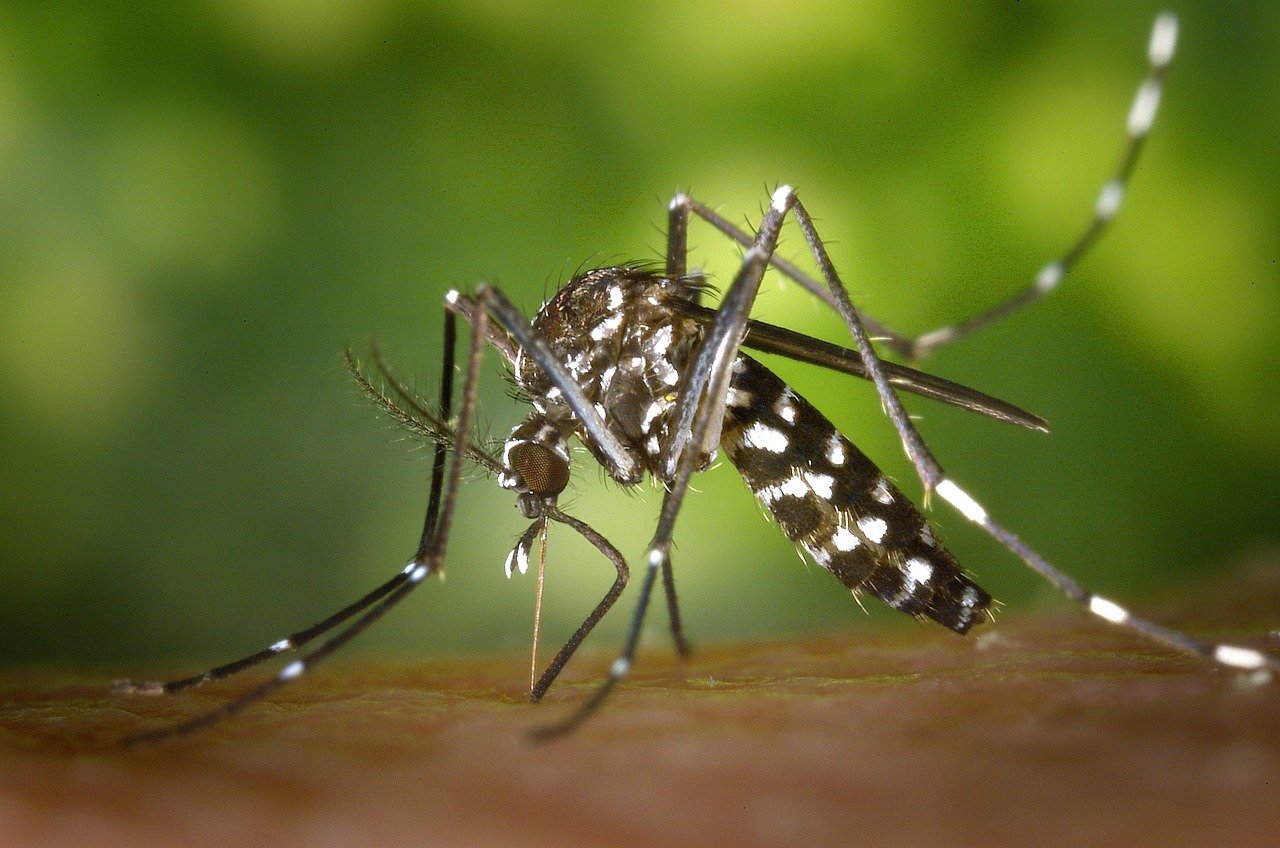
Its body is black with bright white markings. It has white bands on its legs and a single white stripe running along the top of the thorax. These markings resemble the pattern of a tiger, which is where its common name comes from.
It is usually a little smaller than the common house mosquito, but its behavior often makes it stand out first. It flies in a fast, irregular way, changing direction constantly, which makes it surprisingly difficult to catch.
Another useful clue is the time of day when it bites. Most people expect mosquitoes to become active after sunset. The Asian tiger mosquito often does exactly the opposite. If you are repeatedly bitten around your home during daylight hours, this species should be one of your first suspects.
Where Did the Asian Tiger Mosquito Come From?
The Asian tiger mosquito is native to the tropical and subtropical forests of Southeast Asia. There it originally bred in water collected inside tree holes and bamboo stems.
Over the past few decades, international trade has helped it spread around the world. Used vehicle tires are considered one of the main pathways because they collect and retain rainwater, allowing eggs to survive long journeys. Lucky bamboo plants and other products that can hold small amounts of water have also contributed to its spread.
Today the species is established across much of southern Europe, large parts of Asia, North and South America, many regions of Africa, and parts of Australia. Its range continues to expand as trade and favorable climates allow it to colonize new areas.
Although it originally lived in forests, it has adapted extremely well to towns and cities. This ability to thrive in human environments is one of the main reasons it has become one of the world's most successful invasive mosquito species.
How Tiger Mosquitoes Live
Understanding the life cycle of the Asian tiger mosquito makes control much easier. Every successful control program is based on breaking this cycle before new adults emerge.
Like all mosquitoes, it passes through four stages: egg, larva, pupa, and adult. The first three stages depend on water, while only the adult lives on land and flies.
The female lays her eggs just above the waterline on the inner walls of containers. The eggs are remarkably resistant and can survive for months even after the water has completely disappeared. When rain or watering raises the water level again, they hatch.
The larvae spend their entire lives in water, feeding on tiny organic particles and microorganisms. After several molts they become pupae, and a few days later the adult mosquito emerges. The new adult rests briefly while its wings and body harden before taking its first flight.
Only female mosquitoes bite people and animals. They need blood to produce eggs. Males feed only on plant nectar and never bite.
Under warm conditions, this cycle can be completed surprisingly quickly, allowing several generations to develop during a single season.
Where Do Tiger Mosquitoes Breed?
Many people believe mosquitoes need ponds, lakes, or dirty water to reproduce. That is one of the most common misconceptions.
The Asian tiger mosquito can complete its life cycle in almost any small container that holds water for several days. Around homes, the most common breeding sites include flower pot trays, buckets, watering cans, clogged gutters, bird baths, rain barrels, children's toys, old tires, plastic containers, and many other objects left outdoors.
The amount of water does not have to be large. Even a very small container may produce dozens of mosquitoes if it remains undisturbed.
This is why removing standing water is usually much more effective than simply trying to kill the adult mosquitoes you see flying around.
How Far Do Tiger Mosquitoes Fly?
People often assume the mosquitoes biting them come from a nearby park, river, or wetland.
In reality, most Asian tiger mosquitoes stay surprisingly close to where they hatch. Many spend their entire lives within a few hundred meters of their breeding site.
If you are being bitten every day in your garden, on your balcony, or around your house, there is a good chance the mosquitoes are coming from somewhere nearby rather than from far away.
This is also why neighborhood cooperation is so important. You may remove every breeding site on your own property, but if a neighboring yard contains several water-filled containers, the problem can continue.
Why Is the Asian Tiger Mosquito Dangerous?
For most people, the first concern is the biting. The bites are often painful, very itchy, and can become extremely irritating because the mosquito may bite several times during a single feeding attempt.
The bigger concern, however, is public health.
The Asian tiger mosquito is a known vector of dengue, chikungunya, Zika, and dog heartworm (dirofilariasis). It has also been shown to transmit or potentially transmit several other diseases, including yellow fever virus, West Nile virus, Japanese encephalitis virus, and Rift Valley fever virus under certain conditions.
Because it feeds on different hosts during its lifetime, it has more opportunities to spread pathogens than species that usually complete a blood meal from a single host.
For this reason, controlling Asian tiger mosquitoes is not only about reducing nuisance. In many parts of the world, it is also an important public health measure.
Final Tips to Control Aedes albopictus Fast
-
Remove water every 3–4 days around home.
-
Combine DIY traps with professional control for big problems.
-
Educate neighbors because mosquito control works only if everyone cleans their yard.
Interested in learning more about mosquitoes and other common pests such as cockroaches, centipedes, rats, flies, and wasps? Explore our blog for detailed guides, expert tips, and effective solutions to keep your home and business pest-free.
For more on indoor pests like this one, see our full Urban & Indoor Pests guide.
Disclaimer
This article is for informational purposes only. Pest control laws and approved chemicals vary by country. For best results and legal safety, we strongly recommend contacting a licensed pest control professional in your local area. Always make sure that the pest control technician is properly certified or licensed, depending on your country’s regulations. It’s important to confirm that they only use approved products and apply them exactly as instructed on the product label. In most places in Europe, UK, or USA, following label directions is not just best practice—it’s the law.
Nasos Iliopoulos,
ΒSc Agronomist & Certified Pest Control Expert
Scientific Director, Advance Services (Athens, Greece)
Licensed Pest Control Business – Ministry of Rural Development & Food (GR)