Codling Moth 
The Codling Moth (Cydia pomonella), commonly known as the codling moth, is one of the most destructive fruit pests in the world. It is primarily associated with apples but can also infest pears, walnuts, quince, and other pome fruits. For orchard owners, farmers, and home gardeners, codling moth infestations can cause severe economic losses and significant reductions in fruit quality.
Most people recognize codling moth damage when they cut open an apple and find a tunnel leading to the core, often accompanied by frass (insect waste) and a feeding larva. Effective codling moth management requires understanding its biology, seasonal activity, and integrated control methods.
What Is Codling Moth?
Codling moth (Cydia pomonella) is a small moth belonging to the family Tortricidae. Its larvae are commonly called "apple worms" because they bore into developing fruit and feed internally. The insect is considered one of the most important pests of commercial apple production worldwide.[1]
Unlike many fruit pests that feed externally, codling moth larvae develop inside the fruit, making infestations difficult to detect until harvest.
Identification
Adult Moth
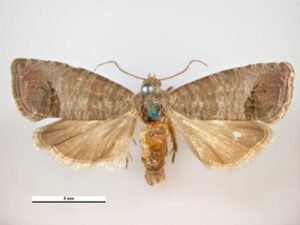
The adult codling moth is relatively small, measuring approximately 10–20 mm in wingspan. The forewings are grayish-brown with distinctive coppery-bronze markings near the wing tips.
Adults are mostly active during dusk and nighttime, making them difficult to observe in orchards.
Larvae
The larva is creamy white to pinkish with a brown head capsule. Fully developed larvae reach about 12–18 mm in length.
These larvae are responsible for virtually all economic damage associated with codling moth infestations.
Eggs
Eggs are tiny, flat, and translucent. They are usually deposited individually on leaves, fruit, or nearby twigs.
Biology & Ecology
The codling moth undergoes complete metamorphosis through four life stages: egg, larva, pupa, and adult.
Females lay eggs shortly after mating. After hatching, young larvae quickly enter developing fruit where they feed on flesh and seeds. Once mature, larvae exit the fruit and seek sheltered locations beneath bark, in orchard debris, or in nearby structures where they pupate.
Depending on climate, codling moth may produce one to four generations annually.[2]
Warmer regions generally experience more generations and higher pest pressure than cooler production areas.
In practice, many growers believe that removing visibly damaged apples solves the problem. However, technicians frequently find larvae already leaving infested fruit and moving into bark crevices where they survive until the next generation emerges.
Global Distribution
Codling moth is native to Europe but has spread to nearly every major fruit-producing region worldwide.
Today it is established throughout:
- Europe
- North America
- South America
- Australia
- New Zealand
- Parts of Asia
- South Africa
Its distribution closely follows commercial apple and pear cultivation.[3]
Risks and Damage
The primary damage results from larval feeding inside fruit.
Economic impacts include:
- Direct fruit destruction
- Reduced market value
- Premature fruit drop
- Secondary fungal infections
- Export restrictions and quarantine concerns
Infested fruit often becomes unsuitable for fresh markets and may also suffer reduced processing quality.
What most people don't realize is that even low codling moth populations can create significant commercial losses. A small percentage of damaged fruit may cause entire shipments to fail quality standards in export markets.
Codling moth often occurs alongside other orchard pests such as Oriental Fruit Moth, Apple Maggot, and various scale insects. See our guide on Oriental Fruit Moth for comparison.
Signs of Codling Moth Infestation
Recognizing early signs is essential for successful management.
Common indicators include:
- Small entry holes on fruit surface
- Reddish-brown frass near the entry point
- Tunnels leading toward the fruit core
- Premature fruit drop
- Larvae found inside apples or pears
- Increased captures in pheromone traps
Most homeowners notice infestation only after cutting open harvested fruit. Unfortunately, by that stage the larval feeding cycle has already been completed.
Control and Prevention Methods
Monitoring
Pheromone traps are one of the most effective monitoring tools. They help determine adult emergence and population trends, allowing treatment timing to be optimized.[1]
Sanitation
Removing fallen and infested fruit significantly reduces future populations.
Orchard sanitation should include:
- Collection of dropped fruit
- Removal of infested fruit from trees
- Cleaning storage areas
- Elimination of overwintering sites where practical
Tree Banding
Corrugated cardboard bands placed around trunks can trap wandering larvae seeking pupation sites. Bands should be inspected and destroyed regularly.
Biological Control
Natural enemies including parasitoid wasps contribute to population suppression. While biological control alone rarely eliminates codling moth, it can support integrated management programs.
A common mistake is relying entirely on broad-spectrum insecticides without monitoring. This often leads to poorly timed applications, unnecessary treatments, and disruption of beneficial insects that naturally help suppress pest populations.
Advanced and Professional Approaches
Mating Disruption
Mating disruption uses synthetic pheromones to interfere with male moths locating females.
This technique has become a cornerstone of modern codling moth management in many commercial orchards.[1]
Degree-Day Models
Professional pest managers often use degree-day calculations to predict egg hatch and optimize treatment timing.
This approach increases control effectiveness while reducing unnecessary pesticide applications.
Integrated Pest Management (IPM)
Integrated Pest Management combines monitoring, biological control, sanitation, mating disruption, and carefully timed treatments.
In practice, successful commercial orchards rarely depend on a single control method. Instead, they combine multiple tactics throughout the season to maintain codling moth populations below economic thresholds.
For related orchard pest management strategies, see our guide on Apple Maggot infestations.
FAQ
What causes codling moth infestations?
Infestations occur when adult moths lay eggs on fruit trees. Emerging larvae enter fruit and develop internally.
How do I know if apples have codling moth larvae?
Look for small holes, frass deposits, and tunnels leading toward the core. Cutting fruit open often reveals larvae.
Can codling moth damage pears?
Yes. Pears are among the primary hosts, along with apples, walnuts, and quince.
How many generations occur each year?
Depending on climate, codling moth can produce one to four generations annually.
What is the best treatment for codling moth?
Integrated Pest Management using pheromone monitoring, sanitation, mating disruption, and properly timed treatments generally provides the best results.
Are codling moths dangerous to humans?
No. They do not bite or transmit diseases to humans. The concern is economic and agricultural damage.
Can home gardeners control codling moth successfully?
Yes. Consistent monitoring, removal of infested fruit, and proper timing of treatments can significantly reduce damage.
Final Thoughts
Codling moth remains one of the most challenging pests of apples and other pome fruits worldwide. Because larvae develop inside fruit, early detection and prevention are essential. Successful management relies on understanding pest biology, monitoring adult activity, maintaining orchard sanitation, and implementing integrated control programs.
Whether managing a commercial orchard or a backyard fruit tree, a proactive approach will always be more effective than reacting after damage becomes visible.
Disclaimer
This article is for informational purposes only. Food safety (HACCP) and pest control requirements vary by country, authority, and type of food business. For legal compliance and audit readiness, always consult a qualified HACCP professional and a licensed pest control operator in your area.
All pest control measures must use approved products and be applied strictly according to the product label, as required by law in most jurisdictions (including the EU, UK, and USA). Improper use of pesticides, lack of documentation, or absence of a structured pest monitoring program may lead to non-compliance, fines, or business closure.
A compliant system must include documented procedures, monitoring records, corrective actions, and verification. Pest control is not optional—it is a core prerequisite program under HACCP and must be properly implemented, recorded, and reviewed.
Author Bio
BSc Agronomist & Certified Pest Control Expert
Scientific Director – Advance Services (Athens, Greece)
Licensed Pest Control Business – Ministry of Rural Development & Food (GR)