European Corn Borer
The European Corn Borer (Ostrinia nubilalis) is one of the most destructive pests affecting corn and several other agricultural crops. Although it was first introduced to North America from Europe in the early 1900s, it is now widely distributed across Europe, Asia, North America, and parts of North Africa. The larvae tunnel into plant stems, stalks, ears, and fruits, weakening plants, reducing yields, and creating entry points for disease-causing fungi. Early detection and integrated pest management are essential for minimizing crop losses.
What is the European Corn Borer? The European Corn Borer is the larval stage of the moth Ostrinia nubilalis. Unlike leaf-feeding caterpillars, its larvae bore into plant tissues, making infestations difficult to detect and control once they enter the stem or ear. Corn is its primary host, but it attacks more than 200 plant species.
Identification of European Corn Borer
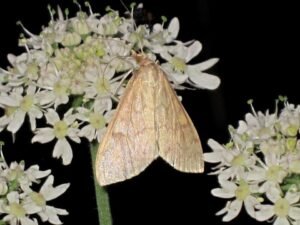
Adult moths are small, measuring about 20–30 mm across the wings. Females are pale yellow to light brown with irregular darker wavy lines across the forewings, while males are generally darker.
The larvae are creamy white to pale pink with small dark spots on each body segment and a brown head capsule. Fully grown caterpillars reach approximately 20–25 mm in length.
Egg masses are laid on the underside of leaves in overlapping clusters that resemble fish scales.
Biology & Ecology
The European Corn Borer undergoes complete metamorphosis through egg, larva, pupa, and adult stages. Depending on climate, one to four generations may occur annually.
Females lay egg masses on host plants during the growing season. After hatching, young larvae feed briefly on leaf surfaces before boring into stalks, leaf midribs, ears, or stems where they remain protected throughout development.
Larvae overwinter inside crop residues before pupating and emerging as adult moths in spring.
In practice, technicians often observe broken corn stalks after strong winds, only to discover extensive internal tunneling caused by European Corn Borer larvae. By the time external symptoms become obvious, much of the internal damage has already occurred.
Global Distribution
The European Corn Borer is native to Europe and western Asia but has spread throughout much of North America. It remains an important pest wherever corn is cultivated and also affects peppers, potatoes, beans, hops, apples, and numerous vegetable crops.
Its distribution is strongly influenced by climate, crop availability, and overwintering success.
Risks and Crop Damage
Larval feeding weakens plant structure, reduces nutrient transport, and increases susceptibility to lodging and fungal diseases.
Common host plants include:
- Corn (maize)
- Peppers
- Beans
- Potatoes
- Tomatoes
- Hops
- Apples
- Sorghum
- Various ornamental plants
Stem tunneling reduces crop yields, while feeding on ears and fruits lowers market quality and creates entry points for secondary pathogens.
A common mistake is focusing only on leaf damage during scouting. European Corn Borer causes its greatest economic losses after larvae tunnel inside stalks, where they remain hidden and protected from many insecticide applications.
Signs of European Corn Borer Infestation
Early scouting helps reduce severe infestations. Typical signs include:
- Small feeding holes in leaves.
- Shot-hole patterns on young leaves.
- Sawdust-like frass near stem entry holes.
- Tunnels inside stalks and ears.
- Broken stalks caused by internal weakening.
- Poor ear development and reduced grain production.
Control and Prevention Methods
Integrated Pest Management (IPM) offers the most effective and sustainable control strategy.
- Monitor adult moth activity using pheromone traps.
- Scout fields regularly for egg masses and young larvae.
- Destroy crop residues after harvest to reduce overwintering larvae.
- Rotate crops when appropriate.
- Encourage beneficial parasitoid wasps and predators.
- Apply registered insecticides before larvae bore into plant tissues.
- Use resistant or Bt corn hybrids where available and appropriate.
Because larvae quickly become protected inside stalks, treatment timing is far more important than repeated insecticide applications.
For comparison, see our guide on Corn Earworm and our article about Fall Armyworm, two other major pests affecting corn production.
Advanced Professional Approaches
Commercial producers combine pheromone monitoring, field scouting, predictive degree-day models, biological control agents, and resistant crop varieties to reduce infestations while minimizing insecticide use.
What most people don't realize is that insecticides have limited effectiveness once larvae enter the stalk. Professional management focuses on monitoring moth flights and treating fields before boring begins, significantly improving control success.
Frequently Asked Questions
What is the European Corn Borer?
The European Corn Borer is the caterpillar stage of the moth Ostrinia nubilalis, a major agricultural pest that attacks corn and more than 200 plant species.
Is European Corn Borer harmful to humans?
No. It does not bite or transmit diseases to people, but it causes significant economic losses in agriculture.
Which crops are most affected?
Corn is the primary host, although peppers, beans, potatoes, tomatoes, hops, apples, and other crops may also be attacked.
How does European Corn Borer spread?
Adult moths fly between fields and lay eggs on suitable host plants during the growing season.
What is the best treatment for European Corn Borer?
Integrated Pest Management using monitoring, crop sanitation, biological control, resistant varieties, and properly timed insecticide applications provides the most effective control.
Can biological control reduce infestations?
Yes. Several parasitoid wasps, particularly species of Trichogramma, naturally attack European Corn Borer eggs and help suppress populations.
Final Thoughts
European Corn Borer remains one of the most important pests affecting corn production worldwide. Successful management depends on early monitoring, accurate timing of control measures, and integrated pest management strategies that combine cultural, biological, and chemical approaches for long-term sustainability.
Disclaimer
This article is for informational purposes only. Food safety (HACCP) and pest control requirements vary by country, authority, and type of food business. For legal compliance and audit readiness, always consult a qualified HACCP professional and a licensed pest control operator in your area.
All pest control measures must use approved products and be applied strictly according to the product label, as required by law in most jurisdictions (including the EU, UK, and USA). Improper use of pesticides, lack of documentation, or absence of a structured pest monitoring program may lead to non-compliance, fines, or business closure.
A compliant system must include documented procedures, monitoring records, corrective actions, and verification. Pest control is not optional—it is a core prerequisite program under HACCP and must be properly implemented, recorded, and reviewed.
Author Bio
BSc Agronomist & Certified Pest Control Expert
Scientific Director – Advance Services (Athens, Greece)
Licensed Pest Control Business – Ministry of Rural Development & Food (GR)