 Codling Moth (Cydia pomonella): Identification, Damage, Control, and Prevention Guide
 Codling Moth (Cydia pomonella): Identification, Damage, Control, and Prevention Guide
The Codling Moth (Cydia pomonella) is one of the most destructive pests of apple and pear orchards worldwide. Often called the "worm in the apple," this insect is responsible for millions of dollars in crop losses every year. While adult moths do not damage fruit, their larvae tunnel deep inside apples, pears, walnuts, and quince, making fruit unsuitable for fresh markets and reducing storage quality.
Because larvae develop inside fruit, infestations are often difficult to detect until damage is well advanced. Early monitoring and an integrated pest management (IPM) program are essential for effective control.
What Is the Codling Moth?
The Codling Moth is a small moth belonging to the family Tortricidae. Its caterpillars bore directly into developing fruit, feeding on the flesh and seeds. This hidden feeding habit makes the pest particularly challenging to control once larvae enter the fruit.
Identification
Eggs
Eggs are tiny, flat, oval, and translucent when first laid. Females deposit them individually on leaves, developing fruit, or nearby stems during the growing season.
Larvae
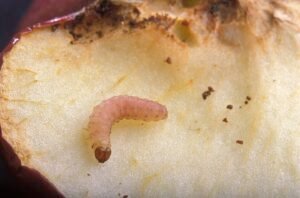
Newly hatched larvae are creamy white with dark heads. As they mature, they develop a characteristic pinkish body with a brown head capsule and grow up to 20 mm long.
Larvae are commonly known as "apple worms" because they tunnel directly into fruit shortly after hatching.
Pupae
After completing development, mature larvae leave the fruit and spin silken cocoons beneath loose bark, in pruning wounds, packing materials, or sheltered locations where they pupate.
Adults
Adult moths have a wingspan of approximately 15–20 mm. Their gray-brown forewings display fine wavy markings and a distinctive metallic bronze patch near the wing tips, making them recognizable during monitoring.
Biology & Ecology
The Codling Moth life cycle consists of egg, larva, pupa, and adult stages. Depending on local climate, the insect produces one to four generations each year.
Adult moths emerge during spring as temperatures increase. After mating, females lay eggs on developing fruit and nearby foliage. Newly hatched larvae quickly bore into fruit, where they remain protected until fully developed.
Once mature, larvae leave the fruit and seek sheltered locations to pupate or overwinter.
Global Distribution
Codling Moth occurs throughout Europe, North America, Asia, South America, Australia, New Zealand, and parts of Africa. Because it is closely associated with commercial fruit production, it is considered one of the world's most economically important orchard pests.
Risks & Damage
Larval feeding causes direct fruit damage and significantly reduces commercial value. Entry holes often become infected with fungi and bacteria, leading to premature fruit drop and storage losses.
Typical damage includes:
- Small entry holes on fruit surface
- Brown frass around entry points
- Tunnels leading to the core
- Seeds destroyed by feeding larvae
- Premature fruit drop
- Internal fruit rot
- Reduced market quality
In practice, growers frequently notice the first signs when windfall apples contain pink caterpillars. Unfortunately, by this stage, many additional larvae are already hidden inside fruit still hanging on the tree.
Signs of Codling Moth Infestation
Early detection allows growers to intervene before widespread fruit damage occurs.
- Small round holes on developing fruit
- Brown sawdust-like frass around entry holes
- Premature fruit drop
- Pink caterpillars inside apples or pears
- Tunnels extending to the fruit core
- Adult moths captured in pheromone traps
A common mistake is assuming damaged fruit contains only one generation of larvae. In warmer climates, multiple generations may attack fruit throughout the season, requiring continuous monitoring.
Control & Prevention Methods
Monitoring
Pheromone traps are widely used to monitor adult moth activity and determine the correct timing for control measures.
Orchard Sanitation
- Remove fallen fruit regularly.
- Destroy infested fruit.
- Remove loose bark where larvae overwinter.
- Keep orchards clean throughout the season.
Cultural Practices
Proper pruning improves air circulation and spray coverage while reducing protected areas where larvae may hide.
Biological Control
Natural enemies including parasitoid wasps, predatory insects, birds, and entomopathogenic nematodes help suppress Codling Moth populations. Mating disruption using pheromone dispensers has become an important non-chemical management tool in many commercial orchards.
Chemical Control
Where necessary, registered insecticides should be applied according to monitoring results and local recommendations. Applications are most effective shortly after egg hatch before larvae enter the fruit.
Advanced Professional Approaches
Professional orchard managers combine pheromone trapping, degree-day models, mating disruption, sanitation, biological control, and selective insecticides within a comprehensive Integrated Pest Management (IPM) program.
What most people don't realize is that spraying after larvae have entered the fruit provides very limited control because the caterpillars remain protected inside the apple. Successful management depends far more on proper timing than on increasing spray frequency.
If you grow apples, you may also find our guide on Apple Maggot useful, as both pests damage fruit internally. See our article on Oriental Fruit Moth for another important orchard pest affecting apples, peaches, and other fruit trees.
FAQ
What fruits does Codling Moth attack?
It primarily attacks apples and pears but may also infest walnuts, quince, crabapples, and several other fruit crops.
Why is it called the "worm in the apple"?
The pink caterpillar tunnels directly into apples, creating the classic "wormy apple" appearance.
How many generations occur each year?
Depending on climate, Codling Moth may complete one to four generations annually.
How do growers monitor Codling Moth?
Pheromone traps are the standard monitoring tool used to detect adult moth activity and guide treatment timing.
Can fallen fruit increase infestations?
Yes. Larvae developing inside dropped fruit often survive and contribute to future generations if not removed.
What is the best treatment for Codling Moth?
The most effective strategy combines pheromone monitoring, orchard sanitation, mating disruption, biological control, and properly timed insecticide applications when necessary.
Final Thoughts
The Codling Moth remains one of the world's most important orchard pests because its larvae feed safely inside developing fruit, where they are difficult to control. Regular monitoring, sanitation, and integrated pest management provide the most reliable long-term protection for commercial orchards and home fruit trees alike.
Disclaimer
This article is for informational purposes only. Food safety (HACCP) and pest control requirements vary by country, authority, and type of food business. For legal compliance and audit readiness, always consult a qualified HACCP professional and a licensed pest control operator in your area.
All pest control measures must use approved products and be applied strictly according to the product label, as required by law in most jurisdictions (including the EU, UK, and USA). Improper use of pesticides, lack of documentation, or absence of a structured pest monitoring program may lead to non-compliance, fines, or business closure.
A compliant system must include documented procedures, monitoring records, corrective actions, and verification. Pest control is not optional—it is a core prerequisite program under HACCP and must be properly implemented, recorded, and reviewed.
Author Bio
BSc Agronomist & Certified Pest Control Expert
Scientific Director – Advance Services (Athens, Greece)
Licensed Pest Control Business – Ministry of Rural Development & Food (GR)