Soybean Cyst Nematode 
The Soybean Cyst Nematode (Heterodera glycines) is the most economically damaging pest of soybeans worldwide. This microscopic roundworm attacks soybean roots, reducing water and nutrient uptake while significantly lowering crop yields. Unlike insects that feed above ground, Soybean Cyst Nematodes live in the soil, making infestations difficult to detect until substantial losses have already occurred.
Yield reductions often develop long before visible symptoms appear, making routine soil sampling and integrated pest management (IPM) essential for protecting soybean production.
What Is the Soybean Cyst Nematode?
The Soybean Cyst Nematode is a microscopic plant-parasitic nematode belonging to the family Heteroderidae. It infects soybean roots by penetrating root tissue and establishing specialized feeding sites that divert nutrients from the plant. Female nematodes eventually swell and become lemon-shaped cysts filled with hundreds of eggs capable of surviving in soil for many years.
Identification
Eggs
Eggs are microscopic and protected inside the hardened body of the female, known as a cyst. A single cyst may contain more than 200 eggs.
Juveniles
The infective second-stage juveniles hatch from eggs and move through soil in search of soybean roots. These microscopic worms are transparent and impossible to detect without magnification.
Adult Females
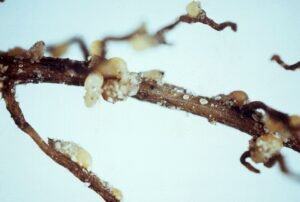
Adult females become swollen and lemon-shaped, changing from white to yellow and finally brown as they mature into protective cysts attached to soybean roots.
Adult Males
Adult males are slender, worm-like, and mobile. After mating, they die shortly afterward while females remain attached to roots.
Biology & Ecology
Soybean Cyst Nematodes survive between crops inside durable cysts that protect eggs from environmental stress. These cysts can remain viable in soil for many years, even in the absence of soybean crops.
When soybean roots are present, juveniles hatch and invade root tissue. Feeding disrupts normal plant development while reducing the plant's ability to absorb water and nutrients.
Warm soil temperatures and continuous soybean production favor rapid population increases.
Global Distribution
Soybean Cyst Nematode occurs throughout North America, South America, Europe, Asia, and many other soybean-producing regions. It has become one of the most widespread and economically important nematode pests of agriculture worldwide.
Risks & Damage
Infested plants often suffer significant yield losses despite appearing only mildly stressed above ground.
Typical damage includes:
- Reduced root development
- Stunted plant growth
- Yellowing leaves
- Poor nutrient uptake
- Reduced pod production
- Lower seed yield
- Patchy areas of weak crop growth
In practice, growers frequently attribute uneven soybean growth to drought or nutrient deficiencies. However, soil testing often reveals high Soybean Cyst Nematode populations even where no obvious root damage is visible.
Signs of Soybean Cyst Nematode Infestation
Early infestations may produce few visible symptoms, making diagnosis difficult without sampling.
- Patchy areas of stunted plants
- Yellow or pale green foliage
- Reduced root systems
- Tiny white or yellow cysts attached to roots
- Reduced yields despite adequate fertility
A common mistake is applying additional fertilizer without confirming the underlying cause of poor crop performance. Nutrient uptake remains limited if damaged roots cannot function normally due to nematode feeding.
Control & Prevention Methods
Soil Testing
Routine soil sampling is the most reliable method for detecting Soybean Cyst Nematode populations before severe economic losses occur.
Crop Rotation
Rotating soybeans with non-host crops such as corn or small grains helps reduce nematode populations over time.
Resistant Varieties
Planting soybean varieties with resistance to Soybean Cyst Nematode remains one of the most effective management strategies. Rotating different resistance sources helps reduce selection pressure on nematode populations.
Sanitation
- Clean machinery before moving between fields.
- Reduce movement of contaminated soil.
- Use certified seed.
- Manage volunteer soybean plants and weed hosts.
Chemical and Biological Control
Several seed treatments and biological nematicides may reduce early infection, but they work best when combined with resistant varieties and crop rotation rather than used alone.
Advanced Professional Approaches
Commercial soybean producers increasingly use Integrated Pest Management programs that combine soil testing, resistant cultivars, crop rotation, population monitoring, and nematode-resistant genetics to maintain profitable production.
What most people don't realize is that substantial yield losses may occur before visible symptoms appear. Waiting until obvious yellow patches develop often means economic damage has already occurred, making preventive soil sampling one of the most valuable management tools available.
If you grow soybeans, see our guide on Soybean Aphid for another economically important soybean pest. You may also find our article on Root-Knot Nematodes useful for comparing different nematode species affecting agricultural crops.
FAQ
What crops does Soybean Cyst Nematode attack?
Soybeans are the primary host, although some closely related legumes and certain weed species may also support reproduction.
Can Soybean Cyst Nematode survive without soybeans?
Yes. Eggs protected inside cysts may survive in soil for many years even when soybeans are absent.
How does Soybean Cyst Nematode spread?
It spreads mainly through movement of contaminated soil on machinery, equipment, water, and planting material.
What is the best treatment for Soybean Cyst Nematode?
Using resistant soybean varieties together with crop rotation and regular soil testing provides the most effective long-term management.
Can nematicides eliminate Soybean Cyst Nematode?
No. Nematicides may reduce populations, but they should be combined with integrated management practices for sustainable control.
How can growers detect infestations early?
Routine soil testing and careful examination of soybean roots for white or yellow cysts provide the earliest and most reliable diagnosis.
Final Thoughts
Soybean Cyst Nematode remains the most important soybean pest because it quietly reduces yields while remaining hidden below ground. Regular soil sampling, resistant soybean varieties, crop rotation, and integrated pest management offer the best long-term protection against this persistent agricultural pest.
Learn more about Agricultural & Outdoor Pests
Disclaimer
This article is for informational purposes only. Food safety (HACCP) and pest control requirements vary by country, authority, and type of food business. For legal compliance and audit readiness, always consult a qualified HACCP professional and a licensed pest control operator in your area.
All pest control measures must use approved products and be applied strictly according to the product label, as required by law in most jurisdictions (including the EU, UK, and USA). Improper use of pesticides, lack of documentation, or absence of a structured pest monitoring program may lead to non-compliance, fines, or business closure.
A compliant system must include documented procedures, monitoring records, corrective actions, and verification. Pest control is not optional—it is a core prerequisite program under HACCP and must be properly implemented, recorded, and reviewed.
Author Bio
BSc Agronomist & Certified Pest Control Expert
Scientific Director – Advance Services (Athens, Greece)
Licensed Pest Control Business – Ministry of Rural Development & Food (GR)