Asian Citrus Psyllid
The Asian Citrus Psyllid (Diaphorina citri) is one of the most destructive pests affecting citrus production worldwide. While the insect itself causes damage by feeding on young shoots and leaves, its
greatest importance comes from transmitting Huanglongbing (HLB), also known as Citrus Greening Disease. This devastating bacterial disease has no cure and has caused billions of dollars in losses to the global citrus industry.
Because even low psyllid populations can spread the disease, early detection and integrated pest management (IPM) are essential for protecting citrus orchards and home gardens.
What Is the Asian Citrus Psyllid?
The Asian Citrus Psyllid is a tiny sap-feeding insect belonging to the family Liviidae. It feeds primarily on tender citrus flushes and closely related plants. During feeding, infected psyllids can transmit the bacterium Candidatus Liberibacter asiaticus, the primary cause of Citrus Greening Disease.
Identification
Eggs
Eggs are tiny, almond-shaped, and bright yellow to orange. Females deposit them on the tips of newly developing shoots and unfolding leaves.
Nymphs
Nymphs are flattened, yellow-orange insects that remain attached to young shoots while feeding. They produce white waxy secretions and are commonly found clustered on tender new growth.
Adults
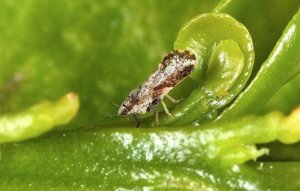
Adult psyllids measure approximately 3–4 mm long. They have mottled brown bodies with transparent wings and characteristically feed at a 45-degree angle to the leaf surface, making them relatively easy to recognize.
Biology & Ecology
Asian Citrus Psyllids reproduce rapidly under warm conditions and may complete numerous generations each year wherever citrus produces repeated flushes of new growth.
Females lay hundreds of eggs during their lifetime. Newly hatched nymphs feed exclusively on young shoots, while adults can move between trees and disperse over considerable distances.
Because both nymphs and adults feed on phloem sap, they weaken young growth and may spread Citrus Greening Disease throughout entire orchards.
Global Distribution
Asian Citrus Psyllid is widely distributed throughout Asia, the Middle East, Africa, South America, Central America, Mexico, the Caribbean, and parts of the United States, including Florida, Texas, Arizona, and California. It continues to expand through international trade and natural dispersal.
Risks & Damage
Direct feeding causes distorted shoots, while disease transmission creates far greater economic losses.
Common damage includes:
- Curled and distorted new leaves
- Stunted shoot growth
- Premature leaf drop
- Reduced fruit production
- Misshapen, bitter fruit
- Tree decline
- Transmission of Citrus Greening Disease
In practice, technicians often detect Asian Citrus Psyllids during routine inspections of young flushes before obvious tree decline develops. Catching infestations early greatly reduces the risk of disease spread.
Signs of Asian Citrus Psyllid Infestation
Careful monitoring during periods of active growth is essential.
- Yellow eggs on young shoots
- Clusters of orange nymphs
- White waxy secretions
- Distorted developing leaves
- Adults feeding at a 45-degree angle
- Irregular yellow shoots associated with Citrus Greening Disease
A common mistake is focusing only on visible feeding damage. Even small psyllid populations can transmit Citrus Greening Disease long before severe symptoms appear, making early monitoring far more important than reacting to visible injury.
Control & Prevention Methods
Monitoring
Inspect young flushes frequently, especially during periods of active shoot growth. Yellow sticky traps may help detect adult psyllids.
Cultural Practices
- Plant certified disease-free nursery stock.
- Remove infected trees when recommended by local authorities.
- Avoid transporting infested citrus plants.
- Maintain healthy orchard management.
Biological Control
Several natural enemies suppress Asian Citrus Psyllid populations, including the parasitoid wasp Tamarixia radiata, lady beetles, lacewings, hoverflies, and spiders. Conserving beneficial insects improves long-term biological control.
Chemical Control
Registered insecticides may be used when monitoring indicates economically important populations. Treatments are generally most effective against young nymphs before populations become widespread.
Advanced Professional Approaches
Commercial citrus producers rely on Integrated Pest Management programs combining monitoring, biological control, certified planting material, coordinated area-wide management, and selective insecticides where necessary.
What most people don't realize is that managing the insect alone is not enough. Because Citrus Greening Disease has no cure, preventing the movement of infected plant material is just as important as reducing psyllid populations.
If you grow citrus, see our guide on Citrus Leafminer, another important citrus pest affecting young foliage. You may also find our article on Citrus Scale Insects helpful for identifying additional sap-feeding pests.
FAQ
What plants does the Asian Citrus Psyllid attack?
It primarily attacks citrus species, including oranges, lemons, limes, mandarins, grapefruits, and several closely related ornamental plants.
Why is the Asian Citrus Psyllid so dangerous?
It spreads Citrus Greening Disease, one of the most destructive diseases affecting citrus production worldwide.
Can Citrus Greening Disease be cured?
No. There is currently no cure for infected trees, making prevention the most effective management strategy.
How does the Asian Citrus Psyllid spread?
Adults fly between citrus trees, while infested nursery plants and plant material can spread the pest over long distances.
What is the best treatment for Asian Citrus Psyllid?
An integrated program combining monitoring, biological control, certified nursery stock, and carefully timed insecticide applications provides the best protection.
Can biological control reduce psyllid populations?
Yes. Parasitoid wasps and predatory insects significantly suppress populations when conserved within integrated pest management programs.
Final Thoughts
The Asian Citrus Psyllid remains one of the greatest threats to citrus production because of its ability to spread Citrus Greening Disease. Vigilant monitoring, healthy planting material, biological control, and integrated pest management provide the strongest long-term defense for commercial orchards and home citrus trees.
Learn more about Agricultural & Outdoor Pests
Disclaimer
This article is for informational purposes only. Food safety (HACCP) and pest control requirements vary by country, authority, and type of food business. For legal compliance and audit readiness, always consult a qualified HACCP professional and a licensed pest control operator in your area.
All pest control measures must use approved products and be applied strictly according to the product label, as required by law in most jurisdictions (including the EU, UK, and USA). Improper use of pesticides, lack of documentation, or absence of a structured pest monitoring program may lead to non-compliance, fines, or business closure.
A compliant system must include documented procedures, monitoring records, corrective actions, and verification. Pest control is not optional—it is a core prerequisite program under HACCP and must be properly implemented, recorded, and reviewed.
Author Bio
BSc Agronomist & Certified Pest Control Expert
Scientific Director – Advance Services (Athens, Greece)
Licensed Pest Control Business – Ministry of Rural Development & Food (GR)