Cucumber Beetles
Cucumber beetles are among the most destructive insect pests affecting cucurbit crops worldwide. The two species most commonly associated with crop damage are the Striped Cucumber Beetle (Acalymma vittatum) and the Spotted Cucumber Beetle (Diabrotica undecimpunctata). Although these beetles are small, their feeding habits and ability to spread plant diseases make them a major concern for home gardeners, commercial growers, and greenhouse producers.
Most growers first notice irregular holes in young cucumber leaves, but the real threat often comes from the diseases these insects transmit. Understanding how cucumber beetles live, spread, and damage plants is essential for successful long-term management.
What Are Cucumber Beetles?
Cucumber beetles are small leaf beetles belonging to the family Chrysomelidae. Both adults and larvae feed on plants in the cucurbit family, including cucumbers, melons, pumpkins, squash, and gourds. Adult beetles attack leaves, flowers, stems, and fruit, while larvae feed mainly on roots and underground plant tissues.
Identification
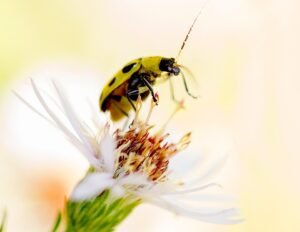
Adult cucumber beetles measure approximately 5–7 mm long and are easily recognized by their bright yellow bodies marked with either black stripes or black spots depending on the species.
The Striped Cucumber Beetle has three distinct black stripes running along its wing covers, while the Spotted Cucumber Beetle has twelve black spots distributed across its yellow-green body.
Eggs are small, orange to yellow, and deposited in the soil near host plants. Larvae are slender, cream-colored, worm-like grubs with brown heads that remain hidden beneath the soil surface.
Biology & Ecology
Adult beetles overwinter in protected vegetation, field edges, crop debris, and wooded areas. As temperatures increase during spring, they emerge and immediately begin searching for young cucurbit plants.
Females lay eggs in the soil close to host plants. After hatching, larvae feed on roots for several weeks before pupating underground. Depending on climate, one to three generations may develop each year.
Adults are highly mobile and can rapidly colonize newly planted fields. Warm temperatures, abundant host plants, and mild winters generally favor population growth.
In practice, technicians often observe the first beetles arriving only a few days after cucumber seedlings emerge. Early infestations are usually the most damaging because young plants have limited ability to recover from feeding injury.
Global Distribution
Cucumber beetles are widely distributed throughout North America and occur in many regions where cucurbit crops are cultivated. Closely related species are also found in Europe, Asia, and other agricultural regions, where they damage cucumbers and other vegetable crops.
Their spread is mainly associated with agricultural production, movement of plant material, and favorable environmental conditions rather than long-distance natural migration.
Risks and Damage
Adult beetles chew irregular holes in leaves, flowers, stems, and developing fruit. Heavy infestations can destroy seedlings before they become established.
The greatest economic damage, however, often results from disease transmission. Striped Cucumber Beetles are well known vectors of bacterial wilt, caused by Erwinia tracheiphila. Once infected, susceptible cucumber plants frequently wilt and die even after beetle populations decline.
Feeding wounds also increase the risk of secondary fungal and bacterial infections while reducing overall plant vigor and marketable yield.
Signs of Cucumber Beetle Infestation
- Small round or irregular holes in leaves.
- Damaged flowers and young fruit.
- Chewed stems on seedlings.
- Poor plant growth.
- Sudden wilting caused by bacterial wilt.
- Visible yellow beetles on foliage during daylight hours.
A common mistake is assuming that a few beetles are harmless. Because even low beetle numbers can introduce bacterial wilt, delaying control measures may result in permanent crop losses.
Control and Prevention Methods
Crop Monitoring
Regular inspections beginning immediately after plant emergence allow growers to detect infestations before populations become established.
Row Covers
Floating row covers provide excellent protection during the early growth stages. Covers should be removed once flowering begins to allow pollination.
Field Sanitation
Removing crop residues and weeds reduces overwintering sites and lowers beetle survival between growing seasons.
Crop Rotation
Rotating cucurbit crops helps reduce local beetle populations, although adults are capable of flying considerable distances in search of new host plants.
Biological Control
Natural enemies such as ground beetles, spiders, parasitic nematodes, and certain predatory insects contribute to population suppression as part of an integrated pest management program.
Chemical Control
When monitoring indicates economically damaging populations, registered insecticides may be used according to local regulations and product labels. Applications are generally most effective against newly arriving adults before extensive feeding or disease transmission occurs.
See also our guide on Squash Vine Borers for another important cucurbit pest that often occurs in the same growing areas.
Advanced Professional Approaches
Professional pest management programs combine monitoring, economic thresholds, cultural practices, resistant varieties where available, biological control, and carefully timed insecticide applications. This integrated approach minimizes unnecessary pesticide use while providing reliable crop protection.
What most people don't realize is that controlling cucumber beetles after bacterial wilt symptoms appear is usually too late. The focus should always be on preventing early feeding rather than reacting after plants begin to collapse.
Frequently Asked Questions
Do cucumber beetles only attack cucumbers?
No. They also feed on squash, pumpkins, melons, gourds, and several related cucurbit crops.
Can cucumber beetles kill young plants?
Yes. Heavy feeding on seedlings can destroy plants before they become established.
Are cucumber beetles harmful to humans?
No. They do not bite people or transmit diseases to humans.
Why are cucumber beetles considered dangerous?
Besides feeding damage, they can spread bacterial wilt, one of the most destructive diseases affecting cucurbits.
What is the best way to get rid of cucumber beetles?
Early monitoring combined with row covers, sanitation, crop rotation, biological control, and targeted insecticide applications when necessary provides the best long-term results.
Can cucumber plants recover after beetle damage?
Light feeding can often be tolerated, but severe infestations or bacterial wilt infections may permanently reduce yield or kill the plant.
Final Thoughts
Cucumber beetles may be small, but they remain one of the most important pests of cucurbit production because they combine direct feeding damage with disease transmission. Early detection, preventive measures, and integrated pest management offer the most reliable strategy for protecting both home gardens and commercial vegetable production.
Learn more about Agricultural & Outdoor Pests
Disclaimer
This article is for informational purposes only. Food safety (HACCP) and pest control requirements vary by country, authority, and type of food business. For legal compliance and audit readiness, always consult a qualified HACCP professional and a licensed pest control operator in your area.
All pest control measures must use approved products and be applied strictly according to the product label, as required by law in most jurisdictions (including the EU, UK, and USA). Improper use of pesticides, lack of documentation, or absence of a structured pest monitoring program may lead to non-compliance, fines, or business closure.
A compliant system must include documented procedures, monitoring records, corrective actions, and verification. Pest control is not optional—it is a core prerequisite program under HACCP and must be properly implemented, recorded, and reviewed.
Author Bio
BSc Agronomist & Certified Pest Control Expert
Scientific Director – Advance Services (Athens, Greece)
Licensed Pest Control Business – Ministry of Rural Development & Food (GR)