 Sugarcane Borer (Diatraea saccharalis): Identification, Damage, and Effective Control Methods
 Sugarcane Borer (Diatraea saccharalis): Identification, Damage, and Effective Control Methods
Diatraea saccharalis, commonly known as the sugarcane borer, is one of the most destructive insect pests affecting sugarcane production throughout the Americas and several other tropical and subtropical regions. Although sugarcane is its primary host, this moth also attacks maize (corn), sorghum, rice, and several wild grasses. The larvae tunnel inside stalks, weakening plants, reducing sugar content, lowering yields, and creating entry points for plant pathogens. Effective management relies on early monitoring and an integrated pest management (IPM) approach.
What is the sugarcane borer?
The sugarcane borer (Diatraea saccharalis) is a stem-boring moth belonging to the family Crambidae. Adult moths lay eggs on sugarcane leaves, and after hatching, the caterpillars bore into the stalks where they remain protected while feeding. Most economic damage is caused by the larval stage.
Identification of Sugarcane Borers
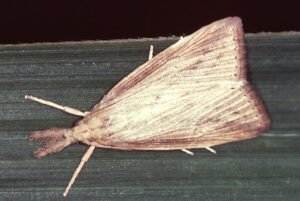
Adult sugarcane borers are small, straw-colored moths with narrow wings spanning approximately 20–30 mm.
Key identification features include:
- Cream to light brown adult moths.
- Narrow forewings with faint longitudinal markings.
- Egg masses laid on the underside of leaves.
- Cream-colored caterpillars with brown heads.
- Mature larvae reaching 20–25 mm in length.
Larvae remain hidden inside stems, making infestations difficult to detect until symptoms become visible.
Biology & Ecology
The sugarcane borer completes a complete metamorphosis consisting of four life stages:
- Egg
- Larva
- Pupa
- Adult moth
Females deposit clusters of eggs on sugarcane leaves. Newly hatched larvae initially feed on leaf tissue before boring into the stalk, where they spend most of their development protected from predators and environmental conditions.
Pupation occurs inside the stem, and newly emerged moths leave through exit holes before beginning another reproductive cycle.
Depending on climate, four to six generations may occur annually, with continuous reproduction possible in tropical regions.
Warm temperatures, high humidity, dense plantings, and year-round host availability favor rapid population growth.
Global Distribution
Diatraea saccharalis is widely distributed throughout sugarcane-growing regions.
Its distribution includes:
- United States (southern states)
- Mexico
- Central America
- Brazil
- Argentina
- Colombia
- Peru
- Caribbean countries
- Several tropical regions of South America
The pest has spread primarily through the movement of infested planting material and natural adult dispersal.
Risks and Damage Caused by Sugarcane Borers
The sugarcane borer causes both direct and indirect damage. Young larvae initially scrape leaf tissue before tunneling into stalks, where feeding continues throughout larval development.
Common damage includes:
- Tunnels inside sugarcane stalks.
- Broken or lodged stems.
- Reduced plant vigor.
- Lower sugar content.
- Poor juice quality.
- Reduced cane weight.
- Yield losses.
Stem tunneling also creates entry points for fungi and bacteria that cause stalk rots, further reducing sugar production and crop quality.
Heavy infestations may significantly reduce both cane yield and sugar recovery, resulting in considerable economic losses for growers and sugar mills.
In practice, technicians often discover severe infestations during harvest when stalks are split open. Extensive internal tunneling and frass-filled galleries may be present even though external symptoms appeared relatively minor throughout the growing season.
Signs of Sugarcane Borer Infestation
Early detection is essential for minimizing losses.
Typical symptoms include:
- Small round holes in stalks.
- Frass near entry holes.
- Dead hearts in young plants.
- Broken stalks.
- Lodged sugarcane.
- Poor cane growth.
- Internal stem tunnels.
Splitting suspect stalks open is one of the most reliable methods for confirming larval infestations.
How to Get Rid of Sugarcane Borers
Integrated Pest Management (IPM) provides the most effective long-term control.
Regular Monitoring
Scout fields regularly for egg masses, entry holes, frass, and dead hearts. Pheromone traps are commonly used to monitor adult moth activity.
Field Sanitation
Destroy crop residues and volunteer host plants after harvest to reduce overwintering populations.
Biological Control
Parasitoid wasps such as Cotesia flavipes have been highly successful in biological control programs. Predatory insects, spiders, and beneficial ants also contribute to natural suppression.
Resistant Varieties
Where available, planting resistant or tolerant sugarcane cultivars helps reduce larval survival and economic damage.
Chemical Control
Registered insecticides may be required when economic thresholds are exceeded. Applications should target newly hatched larvae before they bore into stalks, as larvae inside stems are largely protected from contact insecticides.
A common mistake is waiting until stalk tunneling becomes obvious before taking action. By then, most larvae are already protected inside the stems, greatly reducing treatment effectiveness.
Advanced Professional Approaches
Modern commercial sugarcane production increasingly relies on integrated monitoring programs that combine pheromone trapping, biological control, economic thresholds, and resistant cultivars.
Many successful programs now emphasize conservation and mass release of parasitoid wasps, significantly reducing insecticide dependence while maintaining effective long-term suppression.
What most people don't realize is that the indirect losses caused by fungal infections entering through larval tunnels often exceed the direct feeding damage itself. Protecting stalk integrity therefore has benefits far beyond preventing caterpillar feeding.
Sugarcane growers should also monitor for other important pests such as sugarcane aphids, wireworms, white grubs, termites, and root borers, since multiple pest species often occur simultaneously in commercial plantations.
Frequently Asked Questions
Are sugarcane borers harmful to humans?
No. Sugarcane borers feed only on plants and do not bite humans or livestock.
Which crops do sugarcane borers attack?
They primarily attack sugarcane but also infest maize, sorghum, rice, and several wild grasses.
Which life stage causes the greatest damage?
The caterpillar (larval) stage causes nearly all economic damage by tunneling inside plant stems.
Can biological control manage sugarcane borers?
Yes. Parasitoid wasps, particularly Cotesia flavipes, are highly effective and widely used in commercial IPM programs.
Why is early monitoring important?
Newly hatched larvae are much easier to control before they enter the stalk, where they become protected from many insecticides.
Should every infestation be sprayed?
No. Treatments should be based on field monitoring, moth activity, crop stage, and economic thresholds. Integrated pest management generally provides the most sustainable long-term solution.
Final Thoughts
The sugarcane borer remains one of the most important insect pests affecting sugarcane production worldwide. Because larvae spend most of their lives protected inside plant stems, early detection and timely intervention are essential. Combining biological control, resistant cultivars, field sanitation, regular monitoring, and carefully timed treatments offers the most effective and environmentally responsible strategy for protecting sugarcane yields and maintaining profitable production.
Learn more about Agricultural & Outdoor Pests
Disclaimer
This article is for informational purposes only. Food safety (HACCP) and pest control requirements vary by country, authority, and type of food business. For legal compliance and audit readiness, always consult a qualified HACCP professional and a licensed pest control operator in your area.
All pest control measures must use approved products and be applied strictly according to the product label, as required by law in most jurisdictions (including the EU, UK, and USA). Improper use of pesticides, lack of documentation, or absence of a structured pest monitoring program may lead to non-compliance, fines, or business closure.
A compliant system must include documented procedures, monitoring records, corrective actions, and verification. Pest control is not optional—it is a core prerequisite program under HACCP and must be properly implemented, recorded, and reviewed.
Author Bio
BSc Agronomist & Certified Pest Control Expert
Scientific Director – Advance Services (Athens, Greece)
Licensed Pest Control Business – Ministry of Rural Development & Food (GR)
References