Damsel Bug
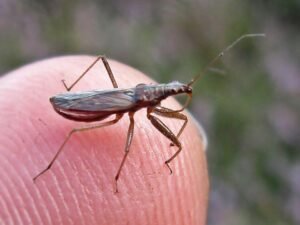
The Damsel Bug (family Nabidae) is one of the most effective beneficial predatory insects found in agricultural fields, home gardens, orchards, and natural habitats. Although its slender body and long legs may resemble those of plant-feeding bugs, the Damsel Bug is actually a highly beneficial predator that feeds on numerous crop pests throughout its life.
Both adults and nymphs actively hunt aphids, caterpillars, leafhoppers, thrips, mites, whiteflies, and many other soft-bodied insects. Their ability to reduce pest populations naturally makes them an important part of Integrated Pest Management (IPM) programs and sustainable agriculture.
What Is the Damsel Bug?
The Damsel Bug (family Nabidae) is a predatory true bug belonging to the order Hemiptera. Unlike plant-feeding bugs, Damsel Bugs use their piercing-sucking mouthparts to capture and consume insect prey. Because they attack many different agricultural pests, they are considered one of the most valuable naturally occurring biological control agents.[1]
Identification
Adult Damsel Bugs measure approximately 8–12 mm in length and have a slender, elongated body. Their color ranges from pale brown to grayish-brown, allowing them to blend easily into grasses and crop foliage.
They possess long legs, narrow wings, and a distinct elongated head with large compound eyes. Their front legs are adapted for grasping prey, while their sharp beak is used to pierce and consume insects.
Nymphs resemble the adults but lack fully developed wings. They are active predators from the moment they hatch and become increasingly efficient hunters as they mature.
Because of their appearance, Damsel Bugs are sometimes confused with pest species. However, they rarely feed on plants and are considered highly beneficial.
Biology & Ecology
Damsel Bugs undergo incomplete metamorphosis, developing through egg, nymph, and adult stages.
Females lay eggs inside plant stems or soft plant tissues where they remain protected until hatching. After emerging, the wingless nymphs immediately begin hunting small insects.
Development speed depends on temperature and prey availability, and several generations may occur each year in warm regions.[2]
Unlike specialist predators, Damsel Bugs are generalists, allowing them to switch prey as pest populations change throughout the growing season.
Global Distribution
Damsel Bugs are widely distributed across:
- North America
- Europe
- Asia
- Australia
- Northern Africa
- Temperate and subtropical agricultural regions worldwide
They are especially common in diverse agricultural landscapes where flowering plants and insect prey are abundant.
Where Are Damsel Bugs Found?
Damsel Bugs are commonly found in:
- Vegetable gardens
- Cereal crops
- Alfalfa fields
- Cotton fields
- Soybean crops
- Fruit orchards
- Vineyards
- Wildflower meadows
They spend most of their time searching vegetation for prey and can often be found moving quickly among leaves and stems.
Benefits of Damsel Bugs
Damsel Bugs provide continuous biological control by feeding on a wide variety of economically important crop pests.
Common prey includes:
- Aphids
- Thrips
- Whiteflies
- Spider mites
- Leafhopper nymphs
- Caterpillar eggs
- Small caterpillars
- Armyworm larvae
- Moth eggs
- Small beetle larvae
By attacking pests at multiple life stages, they help keep damaging insect populations below economically important levels.
See our guides on Big-Eyed Bugs, Green Lacewings, and Lady Beetles to learn about other beneficial predators commonly found in agricultural ecosystems.
How Damsel Bugs Help Control Crop Pests
Damsel Bugs are active hunters that patrol crops throughout the day. Rather than waiting for prey, they actively search leaves, stems, flowers, and the soil surface for insects.
Once prey is located, they quickly seize it using their front legs before piercing the body with their mouthparts and feeding on internal fluids.
Because they consume many different pest species, they continue providing natural pest suppression even when one prey species becomes scarce.
In practice… technicians inspecting vegetable fields often notice Damsel Bugs long before growers realize they are present. During outbreaks of aphids or caterpillars, these predators are frequently observed feeding among damaged plants, helping reduce pest numbers without any intervention.
How to Encourage Damsel Bugs
Healthy Damsel Bug populations can be supported by creating environments that provide food, shelter, and protection from unnecessary pesticide exposure.
- Plant flowering species that support beneficial insects.
- Maintain field margins and natural vegetation.
- Reduce broad-spectrum insecticide applications.
- Encourage crop diversity.
- Monitor beneficial insect populations before spraying.
- Adopt Integrated Pest Management practices.
A common mistake is… assuming that every bug found on crop foliage is harmful. Many beneficial predators, including Damsel Bugs, are unintentionally eliminated during preventive insecticide treatments, reducing one of nature's most effective pest control systems.
Role in Integrated Pest Management (IPM)
Damsel Bugs play an important role in modern Integrated Pest Management programs because they naturally suppress multiple pest species without harming crops.
- Natural biological pest control
- Reduced pesticide dependence
- Support for beneficial insect diversity
- Improved ecological balance
- Sustainable crop protection
- Long-term pest suppression
What most people don't realize is… Damsel Bugs remain effective even when pest populations fluctuate. Their ability to switch between different prey species allows them to stay active throughout the growing season, providing continuous natural pest management.
Frequently Asked Questions
Are Damsel Bugs beneficial?
Yes. They are considered one of the most important beneficial predatory insects in agriculture because they feed on numerous crop pests.
What do Damsel Bugs eat?
They prey on aphids, thrips, whiteflies, spider mites, caterpillars, moth eggs, leafhoppers, and many other soft-bodied insects.
Do Damsel Bugs damage plants?
No. They feed primarily on insects and only rarely probe plant tissue when prey is scarce, causing no significant crop damage.
Can Damsel Bugs help reduce pesticide use?
Yes. By naturally suppressing pest populations, they contribute to Integrated Pest Management programs that rely less on chemical insecticides.
Are Damsel Bugs found in home gardens?
Absolutely. They are common in vegetable gardens, ornamental landscapes, flower beds, and orchards where insect prey is available.
How can I attract Damsel Bugs?
Maintain flowering plants, preserve natural vegetation, minimize broad-spectrum insecticide use, and encourage a diverse garden ecosystem.
Final Thoughts
The Damsel Bug is one of agriculture's most valuable natural predators. By feeding on aphids, caterpillars, thrips, mites, whiteflies, and many other crop pests, it helps maintain healthier crops while reducing the need for chemical insecticides. Protecting these beneficial insects supports sustainable farming, stronger biodiversity, and more resilient agricultural ecosystems.
Learn more about Agricultural & Outdoor Pests
Disclaimer
This article is for informational purposes only. Food safety (HACCP) and pest control requirements vary by country, authority, and type of food business. For legal compliance and audit readiness, always consult a qualified HACCP professional and a licensed pest control operator in your area.
All pest control measures must use approved products and be applied strictly according to the product label, as required by law in most jurisdictions (including the EU, UK, and USA). Improper use of pesticides, lack of documentation, or absence of a structured pest monitoring program may lead to non-compliance, fines, or business closure.
A compliant system must include documented procedures, monitoring records, corrective actions, and verification. Pest control is not optional—it is a core prerequisite program under HACCP and must be properly implemented, recorded, and reviewed.
Author Bio
BSc Agronomist & Certified Pest Control Expert
Scientific Director – Advance Services (Athens, Greece)
Licensed Pest Control Business – Ministry of Rural Development & Food (GR)