Spined Soldier Bug
The Spined Soldier Bug (Podisus maculiventris) is one of the most important beneficial insects used in agriculture, horticulture, and biological pest control. Unlike plant-feeding stink bugs that damage crops, this predatory species actively hunts many destructive insects, making it a valuable ally for farmers, greenhouse growers, and home gardeners.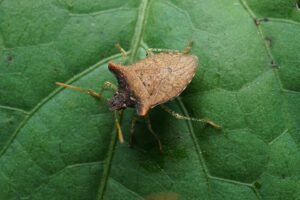
Both adults and nymphs prey on caterpillars, beetle larvae, sawfly larvae, armyworms, and numerous other crop pests. Because it feeds throughout nearly its entire life cycle, the Spined Soldier Bug plays an important role in Integrated Pest Management (IPM) programs and sustainable agriculture.
What Is the Spined Soldier Bug?
The Spined Soldier Bug (Podisus maculiventris) belongs to the family Pentatomidae and the predatory subfamily Asopinae. It is one of the best-studied predatory stink bugs in North America and has been widely used as a biological control agent against agricultural pests. Unlike herbivorous stink bugs, it feeds almost entirely on insects rather than plants.[1]
Identification
Adult Spined Soldier Bugs measure approximately 10–14 mm in length and have the characteristic shield-shaped body typical of stink bugs.
Their coloration ranges from light brown to gray or tan with darker markings. One of the easiest identifying features is the pair of pointed projections, or "spines," located on the shoulders (pronotum), which give the insect its common name.
Nymphs are wingless and often display striking black, orange, red, or cream coloration during their early developmental stages.
Unlike many plant-feeding stink bugs, the Spined Soldier Bug has a thicker, stronger beak designed for piercing insect prey.
Biology & Ecology
The Spined Soldier Bug undergoes incomplete metamorphosis through egg, five nymphal stages, and adult.
Females lay clusters of barrel-shaped eggs on the underside of leaves near suitable prey populations. Shortly after hatching, the young nymphs begin feeding on small insects before progressing to larger prey as they develop.
Both adults and nymphs actively patrol vegetation searching for insects using their excellent vision and piercing-sucking mouthparts.
Depending on environmental conditions, two to three generations may occur annually in many regions.[2]
Global Distribution
The Spined Soldier Bug is native to North America but is widely recognized and studied throughout the world because of its importance in biological pest management.
- North America
- Commercial greenhouses worldwide
- Biological control programs
- Agricultural research facilities
It is commonly found wherever suitable insect prey and crop plants are available.
Where Are Spined Soldier Bugs Found?
These beneficial predators commonly inhabit:
- Vegetable gardens
- Agricultural fields
- Fruit orchards
- Potato crops
- Soybean fields
- Corn fields
- Greenhouses
- Natural vegetation
Adults and nymphs spend most of their time on leaves and stems where insect prey is abundant.
Benefits of Spined Soldier Bugs
The Spined Soldier Bug naturally suppresses numerous economically important agricultural pests.
Its preferred prey includes:
- Colorado potato beetle larvae
- Caterpillars
- Armyworms
- Cutworms
- Cabbage loopers
- Sawfly larvae
- Beetle larvae
- Fall armyworms
- Various soft-bodied insects
Both adults and nymphs actively hunt prey throughout the growing season, providing continuous biological control.
See our guides on Predatory Stink Bugs, Assassin Bugs, and Ground Beetles to learn about other beneficial predators that naturally protect crops.
How Spined Soldier Bugs Help Control Crop Pests
Spined Soldier Bugs actively patrol crop foliage searching for prey. Once an insect is located, they seize it using their legs before inserting their piercing beak into the victim.
Digestive enzymes quickly liquefy the prey's internal tissues, allowing the bug to feed on the nutrient-rich fluids. This feeding strategy enables them to capture insects that are often larger than themselves.
Because they attack pests during both their nymph and adult stages, they provide long-lasting biological control throughout the growing season.
In practice… potato growers frequently observe Spined Soldier Bugs feeding on Colorado potato beetle larvae before serious crop damage develops. Their presence often helps slow pest outbreaks naturally, particularly when broad-spectrum insecticides are avoided.
How to Encourage Spined Soldier Bugs
Healthy populations can be supported by maintaining diverse habitats and protecting beneficial insects.
- Reduce unnecessary broad-spectrum insecticide use.
- Maintain flowering plants throughout the season.
- Preserve natural vegetation around crop fields.
- Encourage biodiversity.
- Monitor pest populations regularly.
- Practice Integrated Pest Management.
A common mistake is… destroying every stink bug found in the garden. While several stink bug species are crop pests, the Spined Soldier Bug is one of the most beneficial predatory insects and should be carefully identified before any control measures are considered.
Role in Integrated Pest Management (IPM)
The Spined Soldier Bug is one of the few predatory stink bugs that has been commercially reared for biological pest control programs.
- Natural suppression of caterpillars
- Control of Colorado potato beetle larvae
- Predation of armyworms
- Reduced pesticide dependence
- Support for biodiversity
- Sustainable crop protection
What most people don't realize is… the Spined Soldier Bug is capable of attacking dozens of different pest species rather than specializing on a single insect. This flexibility allows it to continue providing biological control even as pest populations change throughout the growing season.
Frequently Asked Questions
Is the Spined Soldier Bug beneficial?
Yes. It is one of the most valuable beneficial insects used for biological control of caterpillars, beetle larvae, armyworms, and many other crop pests.
Does the Spined Soldier Bug damage plants?
No. Unlike plant-feeding stink bugs, it feeds primarily on insects and rarely damages healthy plants.
What does the Spined Soldier Bug eat?
It preys on caterpillars, Colorado potato beetle larvae, cutworms, armyworms, sawfly larvae, beetle larvae, and numerous soft-bodied insects.
Can the Spined Soldier Bug control Colorado potato beetles?
Yes. It is considered one of the most effective natural predators of Colorado potato beetle larvae.
Is the Spined Soldier Bug used in biological control?
Yes. It has been commercially reared and released in many biological control programs targeting agricultural pests.
How can I attract Spined Soldier Bugs?
Grow flowering plants, reduce unnecessary insecticide use, preserve natural habitats, and encourage biodiversity throughout gardens and agricultural landscapes.
Final Thoughts
The Spined Soldier Bug is among the most effective beneficial predators available for natural pest management. By feeding on caterpillars, Colorado potato beetle larvae, armyworms, and many other destructive insects throughout both its nymph and adult stages, it helps protect crops while reducing dependence on chemical insecticides. Conserving this remarkable predator through habitat management and Integrated Pest Management supports healthier crops, stronger biodiversity, and more sustainable agriculture.
Learn more about Agricultural & Outdoor Pests
Disclaimer
This article is for informational purposes only. Food safety (HACCP) and pest control requirements vary by country, authority, and type of food business. For legal compliance and audit readiness, always consult a qualified HACCP professional and a licensed pest control operator in your area.
All pest control measures must use approved products and be applied strictly according to the product label, as required by law in most jurisdictions (including the EU, UK, and USA). Improper use of pesticides, lack of documentation, or absence of a structured pest monitoring program may lead to non-compliance, fines, or business closure.
A compliant system must include documented procedures, monitoring records, corrective actions, and verification. Pest control is not optional—it is a core prerequisite program under HACCP and must be properly implemented, recorded, and reviewed.
Author Bio
BSc Agronomist & Certified Pest Control Expert
Scientific Director – Advance Services (Athens, Greece)
Licensed Pest Control Business – Ministry of Rural Development & Food (GR)