Colorado Potato Beetle
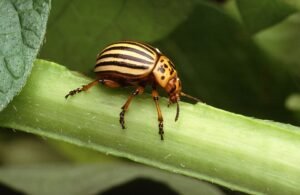
The Colorado potato beetle (Leptinotarsa decemlineata) is one of the most important agricultural pests affecting potatoes worldwide. Known for its remarkable ability to develop resistance to insecticides, this beetle can quickly destroy potato foliage and significantly reduce crop yields if left unmanaged.
Whether you are a homeowner growing potatoes in a garden or a commercial farmer managing large fields, understanding the biology and behavior of the Colorado potato beetle is essential for effective control.
What Is the Colorado Potato Beetle?
The Colorado potato beetle is a leaf-feeding beetle belonging to the family Chrysomelidae. It primarily attacks potato plants but can also infest other members of the nightshade family, including tomatoes, eggplants, and certain wild solanaceous weeds.
Adult beetles are easily recognized by their yellow-orange bodies and ten distinctive black stripes running along their wing covers. Both adults and larvae feed aggressively on plant foliage and can completely defoliate plants during severe infestations.[1]
Identification
Adult Beetles
Adults measure approximately 9–12 mm in length. Their rounded yellow-orange bodies feature five black stripes on each wing cover, giving them their characteristic appearance.
Eggs
Females lay bright yellow to orange eggs in clusters on the underside of leaves. A single female may lay several hundred eggs during her lifetime.[2]
Larvae
Larvae are soft-bodied, hump-backed, and reddish-orange to pink. They possess two rows of black spots along each side of the body and are often responsible for the most severe feeding damage.
Biology & Ecology
The Colorado potato beetle overwinters as an adult in soil, usually along field margins or protected locations. When temperatures increase in spring, adults emerge and begin feeding on newly developing host plants.
After mating, females deposit egg masses on leaves. Eggs hatch within several days, depending on temperature. Larvae pass through four developmental stages before entering the soil to pupate.
Under favorable conditions, multiple generations may occur annually, especially in warmer regions.[3]
One of the reasons this pest is so difficult to manage is its exceptional adaptability. Colorado potato beetles have developed resistance to many classes of insecticides over the last several decades.[4]
Global Distribution
Despite its name, the Colorado potato beetle did not originate in Colorado. It is believed to have originated in parts of Mexico before spreading throughout North America.
Today, the pest is established across much of North America, Europe, and Asia. Its ability to adapt to different climates and host plants has made it one of the most successful agricultural pests globally.
Many countries maintain monitoring programs because infestations can cause substantial economic losses in potato production.
Risks / Damage
The primary damage results from foliage feeding by both larvae and adults.
Heavy infestations can:
- Completely defoliate potato plants.
- Reduce tuber size and quality.
- Delay plant development.
- Lower overall yields.
- Increase production costs due to repeated control measures.
Young plants are particularly vulnerable. Severe early-season defoliation may significantly reduce crop performance.
Although potatoes are the preferred host, tomatoes and eggplants can also suffer serious damage.
For comparison, growers dealing with Colorado potato beetles may also encounter other agricultural pests such as aphids, cutworms, and wireworms. See our guide on aphid infestations for additional crop protection strategies.
Signs of Infestation
Early detection greatly improves management success.
Common signs of Colorado potato beetle infestation include:
- Yellow-orange egg clusters on leaf undersides.
- Small red larvae feeding on leaves.
- Skeletonized foliage.
- Irregular holes in leaves.
- Presence of striped adult beetles.
- Dark droppings on foliage.
- Progressive plant defoliation.
Most homeowners notice the pest first when they see large numbers of bright orange larvae feeding together on potato leaves.
Control & Prevention Methods
Crop Rotation
Crop rotation remains one of the most effective preventive measures. Moving potato crops away from previous growing locations can significantly reduce beetle populations emerging from overwintering sites.
Hand Removal
In small gardens, manually removing adults, larvae, and egg masses can be highly effective.
Mulching
Organic mulches may interfere with beetle movement and reduce colonization of new plants.
Biological Control
Natural enemies including predatory insects, ground beetles, and some parasitoids may help suppress populations. Maintaining biodiversity within agricultural systems can support these beneficial organisms.
Resistant Varieties
Some potato varieties show greater tolerance to feeding damage and may help reduce economic losses.
A common mistake is relying exclusively on insecticide sprays year after year. Because Colorado potato beetles rapidly develop resistance, repeated use of the same active ingredient often becomes ineffective over time.
Advanced / Professional Approaches
Commercial growers typically employ Integrated Pest Management (IPM) programs combining monitoring, cultural controls, biological methods, and selective insecticide applications.
Professional monitoring includes field scouting, economic threshold calculations, and resistance management strategies.
In practice, many potato growers first notice a few adult beetles along field edges in spring and assume the population is insignificant. Within a few weeks, egg masses hatch and larval numbers increase dramatically. By the time severe defoliation becomes visible, substantial crop stress may already have occurred. Early scouting often makes the difference between simple intervention and costly control programs.
What most people don’t realize is that insecticide resistance can develop surprisingly quickly in Colorado potato beetle populations. Rotating active ingredients with different modes of action is often more important than increasing application frequency.
Some biological products containing Bacillus thuringiensis var. tenebrionis may provide suppression of young larvae when applied correctly.[2]
Growers interested in broader vegetable pest management may also benefit from reviewing information on flea beetles and tomato hornworms, which can occur in similar cropping systems.
FAQ Section
Can Colorado potato beetles kill potato plants?
Yes. Severe infestations can completely defoliate potato plants and significantly reduce yield.
Do Colorado potato beetles attack tomatoes?
Yes. Tomatoes, eggplants, and some other plants in the nightshade family can serve as hosts.
How fast do Colorado potato beetles reproduce?
Females can lay several hundred eggs during their lifespan, allowing populations to increase rapidly.
What is the best treatment for Colorado potato beetles?
An integrated approach combining monitoring, crop rotation, manual removal, biological controls, and carefully selected insecticides usually provides the best results.
Can I remove Colorado potato beetles by hand?
Yes. Hand-picking adults, larvae, and egg masses is effective in home gardens and small plantings.
Why are Colorado potato beetles difficult to control?
The species is famous for developing resistance to many insecticides, making long-term management challenging.
When are Colorado potato beetles most active?
Activity typically begins in spring when overwintering adults emerge and continues throughout the growing season.
Final Thoughts
The Colorado potato beetle remains one of the most damaging potato pests in the world. Its rapid reproduction, aggressive feeding behavior, and ability to develop insecticide resistance make it a serious challenge for growers.
Successful management depends on early detection, regular monitoring, crop rotation, and an integrated pest management approach. When addressed early, infestations can often be controlled before significant crop losses occur.
Disclaimer
This article is for informational purposes only. Food safety (HACCP) and pest control requirements vary by country, authority, and type of food business. For legal compliance and audit readiness, always consult a qualified HACCP professional and a licensed pest control operator in your area.
All pest control measures must use approved products and be applied strictly according to the product label, as required by law in most jurisdictions (including the EU, UK, and USA). Improper use of pesticides, lack of documentation, or absence of a structured pest monitoring program may lead to non-compliance, fines, or business closure.
A compliant system must include documented procedures, monitoring records, corrective actions, and verification. Pest control is not optional—it is a core prerequisite program under HACCP and must be properly implemented, recorded, and reviewed.
Author Bio
BSc Agronomist & Certified Pest Control Expert
Scientific Director – Advance Services (Athens, Greece)
Licensed Pest Control Business – Ministry of Rural Development & Food (GR)