Plum Curculio 
The Plum Curculio (Conotrachelus nenuphar) is one of the most destructive insect pests of stone fruits and pome fruits in North America. Despite its name, it attacks far more than plums. Apples, peaches, nectarines, cherries, apricots, pears, and quince are also common hosts. Adult weevils and their larvae damage developing fruit, leading to premature fruit drop, poor fruit quality, and significant economic losses in commercial orchards.
Because adult Plum Curculios become active shortly after trees bloom, early monitoring and timely management are essential. Integrated Pest Management (IPM) remains the most effective strategy for reducing infestations while preserving beneficial insects.
What Is the Plum Curculio?
The Plum Curculio is a small snout beetle belonging to the family Curculionidae. Adult females lay eggs inside young fruit, where larvae develop by feeding internally. Their egg-laying activity leaves a distinctive crescent-shaped scar on the fruit surface, one of the easiest field signs used to identify infestations.
Identification
Eggs
Eggs are tiny, oval, and creamy white. Females deposit them individually beneath the skin of young fruit after cutting a characteristic crescent-shaped slit that protects the developing egg as the fruit expands.
Larvae
Larvae are legless, creamy white grubs with brown heads and curved bodies. Fully developed larvae measure approximately 6–9 mm long and feed inside fruit until maturity.
Pupae
After leaving fallen fruit, mature larvae burrow into the soil where pupation occurs. New adults emerge several weeks later during the growing season.
Adults
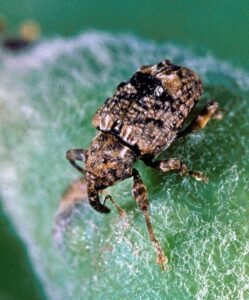
Adult Plum Curculios are small brown weevils measuring about 5–7 mm long. They possess a distinctive curved snout and rough, mottled wing covers marked with patches of gray, brown, black, and white.
Biology & Ecology
The Plum Curculio completes one generation annually across much of its northern range, although partial or additional generations may occur in warmer regions.
Adults overwinter beneath leaf litter, hedgerows, woodland edges, and other protected sites. They become active during spring when temperatures rise and fruit trees begin developing young fruit.
After mating, females lay eggs inside newly formed fruit. Developing larvae feed internally before exiting dropped fruit to pupate in the soil.
Global Distribution
Plum Curculio is native to North America and occurs throughout the eastern United States, southeastern Canada, and parts of the central United States. Because it is regulated in several fruit-producing regions, movement of infested fruit may be subject to quarantine restrictions.
Risks & Damage
Both adults and larvae damage fruit. Adult feeding creates small punctures, while egg-laying causes characteristic crescent scars. Larval feeding destroys developing fruit internally, often causing premature fruit drop.
Common damage includes:
- Crescent-shaped egg-laying scars
- Small feeding punctures
- Premature fruit drop
- Internal larval tunnels
- Deformed fruit
- Reduced market quality
- Secondary fungal infections
In practice, technicians often identify Plum Curculio by the unique crescent-shaped scars long before larvae become visible. These marks provide one of the earliest opportunities to begin management before significant fruit loss occurs.
Signs of Plum Curculio Infestation
Careful orchard inspections shortly after bloom help detect infestations early.
- Crescent-shaped scars on young fruit
- Small feeding holes
- Premature fruit drop
- Larvae inside fallen fruit
- Misshapen or scarred fruit
- Adult weevils found on trees during evening inspections
A common mistake is assuming dropped fruit is caused only by poor pollination or weather. Cutting open fallen fruit often reveals developing Plum Curculio larvae that would otherwise be overlooked.
Control & Prevention Methods
Monitoring
Regular orchard scouting immediately after petal fall is critical. Inspect young fruit for fresh crescent-shaped egg scars and adult feeding damage.
Sanitation
- Collect and destroy fallen fruit frequently.
- Remove infested fruit from the orchard.
- Reduce overwintering sites where practical.
- Maintain orchard hygiene.
Cultural Practices
Pruning to improve light penetration and air circulation makes orchard inspections easier and may improve spray coverage where treatments are required.
Biological Control
Predatory insects, parasitoids, birds, and beneficial entomopathogenic nematodes contribute to natural suppression, particularly against soil-dwelling stages.
Chemical Control
Where economic thresholds are exceeded, registered insecticides may be required. Treatments are generally most effective shortly after petal fall when adults are actively feeding and laying eggs.
Advanced Professional Approaches
Commercial orchards rely on Integrated Pest Management (IPM) programs that combine monitoring, degree-day models, orchard sanitation, selective insecticides, and biological control whenever possible.
What most people don't realize is that removing dropped fruit every few days can significantly reduce future Plum Curculio populations by interrupting larval development before adults emerge from the soil.
If you grow apples, see our guide on Codling Moth for another internal fruit pest. You may also find our article on Oriental Fruit Moth useful if you manage peaches or mixed fruit orchards.
FAQ
What fruit trees does Plum Curculio attack?
It attacks plums, apples, peaches, nectarines, cherries, pears, apricots, quinces, and several other fruit crops.
What is the characteristic sign of Plum Curculio?
The crescent-shaped egg-laying scar on young fruit is the most recognizable sign of infestation.
When are adults most active?
Adults usually become active shortly after bloom during spring as young fruit begins developing.
Does Plum Curculio cause fruit drop?
Yes. Larval feeding frequently causes infested fruit to fall prematurely before harvest.
How does Plum Curculio survive winter?
Adults overwinter beneath leaf litter, woodland edges, brush, and other protected habitats surrounding orchards.
What is the best treatment for Plum Curculio?
An integrated pest management program combining orchard sanitation, careful monitoring, biological control, and properly timed insecticide applications provides the most effective long-term control.
Final Thoughts
The Plum Curculio remains one of North America's most important orchard pests because both adults and larvae damage developing fruit early in the growing season. Regular scouting, orchard sanitation, and integrated pest management provide reliable protection while helping maintain healthy fruit production year after year.
Disclaimer
This article is for informational purposes only. Food safety (HACCP) and pest control requirements vary by country, authority, and type of food business. For legal compliance and audit readiness, always consult a qualified HACCP professional and a licensed pest control operator in your area.
All pest control measures must use approved products and be applied strictly according to the product label, as required by law in most jurisdictions (including the EU, UK, and USA). Improper use of pesticides, lack of documentation, or absence of a structured pest monitoring program may lead to non-compliance, fines, or business closure.
A compliant system must include documented procedures, monitoring records, corrective actions, and verification. Pest control is not optional—it is a core prerequisite program under HACCP and must be properly implemented, recorded, and reviewed.
Author Bio
BSc Agronomist & Certified Pest Control Expert
Scientific Director – Advance Services (Athens, Greece)
Licensed Pest Control Business – Ministry of Rural Development & Food (GR)