European Hornet Nest Removal in a Cramped Attic: A Real Pest Control Case Study
We got a call about european hornet nest removal. The nest where in an attic. The problem was on the fourth floor, in a small storage loft above the bathroom, in a densely populated residential building in Athens.Why We Scheduled the Job at Dusk
We booked the appointment for early evening, right before nightfall. Here's the reasoning: after sunset, hornets have all returned to the nest, which makes them far easier to manage. The same window works just before sunrise. Working at either of these times means you finish the job in one pass — you're not left with foraging members who were away from the nest during treatment, who then keep showing up afterward, annoying the client and eating into your schedule with a callback.
So we set the appointment for a few days later, at twilight.
Wasps on a balcony
First Look at the European Hornets Nest
I arrived on time, and the client was glad to see that. He noticed my gear but was surprised I hadn't brought a beekeeper suit. You should always carry one. Sometimes, though, experienced technicians get a little careless and skip it — something I don't recommend, but it happens. The moment he mentioned it, I knew I'd be walking back to the car for it.
I filled the sprayer with water and asked to go up into the attic to assess the situation.
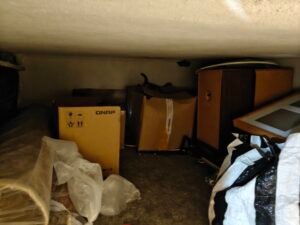
The space was packed with boxes, and up in one corner, where the wall met the ceiling, there was a nest roughly the size of two fists. It held a good number of adult European hornets (Vespa crabro) along with plenty of developing larvae still in their cells.
The nest sat deep inside the attic, in a space that was narrow and ran back a long way. That settled it — the suit was no longer optional.
Choosing the Right Product for a Confined Space
I told them I needed to grab the suit from the car, along with another product that would help. I carry a silicone-based formulation that essentially traps the insect like a web. Combined with pyrethrin, it lets me get out of tight spots like this quickly, without getting stung.
Truth be told, as a professional I've never actually been stung on the job, despite having handled hundreds of these cases. Professionals rarely get stung — it comes with experience and the right approach. For untrained people, though, this is genuinely dangerous, especially if they don't know whether they're allergic. Roughly 1% of people have an allergic reaction to insect stings, and around 0.1% face a life-threatening reaction. These are rough population-level figures, but they illustrate the real risk.
Assessing the Layout Before Treating the Hornet Nest
I checked whether the hallway leading to the attic access could be sealed off. There were no doors leading to the living room or kitchen — only the bathrooms and one or two bedrooms had doors. Their young daughter was in one of those bedrooms.
Nobody in the household planned to leave the apartment during treatment.
My plan was to spray directly onto the nest and the wasps. I wasn't especially worried about hornets escaping and stinging someone — what concerned me more was whether to use an aerosol fogging treatment, in case a second nest was hidden behind the boxes. But an aerosol, before the attic door could be sealed, could easily drift back into the living space. So I ruled that out immediately.
Instead: a direct, targeted spray onto the boxes and straight onto the nest.
The Complication: What Was Actually Stored Up There
I asked what was inside the boxes. Mostly books — a real concern, because heavy product runoff would soak whatever was stored underneath. There were also wedding china, various gifts, suitcases, guitar parts, a guitar stand, speakers, and assorted other equipment.
The client seemed most concerned about the speakers — worried they might get damaged.
I told him I'd figure out how to handle it carefully.
Suiting Up and Treating the Hornet Nest
I put on a mask, got into the suit, grabbed the sprayer, and went up.
July heat, inside an attic in Greece, is brutal.
I sent the couple who'd called us out to the balcony, away from the area.
I climbed the ladder, pushed in as far as I could, and didn't waste time. I pulled the trigger with the product landing directly on the nest.
At that point I noticed shadows moving around from insects in flight — completely normal in this kind of job.
An Unexpected Discovery: Cockroaches in the Attic
What I quickly realized, though, was that there were also cockroaches present.
What I hadn't mentioned yet: the hornets had entered the attic through a ventilation opening built into the apartment block's structure. It had a mesh screen that was supposed to seal it off, but years of wear had torn it.
By the time I arrived, it wasn't just the hornets exploiting that torn mesh — cockroaches had found it too. Though they may well have also been coming up through the bathroom drains directly below.
So now it wasn't just a hornet treatment. I needed to treat the whole attic space.
But the space was packed with belongings.
I decided a pass along the open edges I could actually reach would be sufficient, and treated accordingly.
Wrapping Up the Job
I soaked the nest thoroughly with product, treated the accessible edges, and climbed back down.
Getting down wasn't easy — I'm a big guy, and it's a tight space. I scraped myself up a bit squeezing out.
The job itself didn't take long, but I was completely worn out.
I asked for tape and sealed off the attic entrance. Through a small gap that was still uncovered, I soon saw the antenna of a cockroach trying to make its way out.
Once that was sealed too, I stepped back for a minute to catch my breath and recover.
They offered me water, and I gave them the aftercare instructions.
Aftercare Instructions I Gave the Client
- Don't open the attic for 24 hours.
- Nobody should go in earlier than that.
- Once someone does go in, they should wear gloves.
- Get that ventilation mesh repaired — this is essential.
- Schedule regular preventive pest control treatments going forward.
Then I left.
Unfortunately, the one photo I managed to take came out blurry and unusable.
But honestly, in situations like this, photos and video are the last thing on my mind. What I'm always thinking about is doing the job right, leaving the client satisfied, and walking out in one piece.
Key takeaways for anyone dealing with a hornet nest at home:
- Timing matters. Treat at dusk or dawn, when the full colony is back at the nest.
- Never assume it's a simple job. Confined spaces, stored belongings, and secondary pest issues (like cockroaches sharing the same entry point) can complicate a straightforward hornet removal.
- Structural entry points need repair, not just pest treatment. A torn ventilation screen will keep letting pests back in until it's fixed.
- If you're not a trained professional, don't attempt nest removal yourself — especially without knowing your allergy status.
Disclaimer
This article is for informational purposes only. Food safety (HACCP) and pest control requirements vary by country, authority, and type of food business. For legal compliance and audit readiness, always consult a qualified HACCP professional and a licensed pest control operator in your area.
All pest control measures must use approved products and be applied strictly according to the product label, as required by law in most jurisdictions (including the EU, UK, and USA). Improper use of pesticides, lack of documentation, or absence of a structured pest monitoring program may lead to non-compliance, fines, or business closure.
A compliant system must include documented procedures, monitoring records, corrective actions, and verification. Pest control is not optional—it is a core prerequisite program under HACCP and must be properly implemented, recorded, and reviewed.
Author Bio
BSc Agronomist & Certified Pest Control Expert
Scientific Director – Advance Services (Athens, Greece)
Licensed Pest Control Business – Ministry of Rural Development & Food (GR)