Brown Lacewing
The Brown Lacewing (family Hemerobiidae) is one of the most valuable beneficial insects found in gardens, orchards, forests, vineyards, greenhouses, and agricultural fields. Although often overshadowed by the more familiar Green Lacewing, Brown Lacewings are highly effective predators that help suppress many soft-bodied insect pests throughout the growing season.
Both adults and larvae feed on aphids, whiteflies, mites, scale insects, psyllids, and insect eggs. Their ability to hunt continuously under cooler conditions makes them important contributors to Integrated Pest Management (IPM) and sustainable agriculture.
What Is the Brown Lacewing?
The Brown Lacewing (family Hemerobiidae) belongs to the order Neuroptera, which also includes Green Lacewings, Antlions, and Owlflies. More than 600 Brown Lacewing species have been described worldwide. Unlike many beneficial insects whose adults feed mainly on nectar and pollen, both adult and larval Brown Lacewings are active predators, making them particularly valuable for long-term biological pest control.[1]
Identification
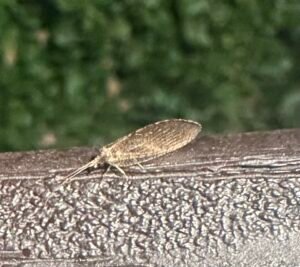
Adult Brown Lacewings are small, delicate insects measuring approximately 5–12 mm in length. They have soft brown bodies, long antennae, and two pairs of transparent wings covered with numerous fine veins.
Unlike the bright green coloration of Green Lacewings, Brown Lacewings display shades of brown, tan, or gray, providing excellent camouflage against tree bark and dried vegetation.
The larvae are elongated, brownish, and equipped with curved sickle-shaped jaws used for capturing prey. Their appearance resembles miniature alligators, although they are generally smaller than Green Lacewing larvae.
Adults are often active during dusk and nighttime, hiding among vegetation during the day.
Biology & Ecology
Brown Lacewings undergo complete metamorphosis through egg, larva, pupa, and adult stages.
Females deposit eggs individually on leaves, bark, or stems near pest colonies. After hatching, larvae immediately begin hunting small insects.
Both larvae and adults actively feed on soft-bodied pests throughout much of their lives. After completing larval development, pupation occurs inside small silk cocoons attached to vegetation or hidden in protected locations.
Several generations may develop each year depending on climate, prey availability, and environmental conditions.[2]
Global Distribution
Brown Lacewings occur throughout:
- Europe
- North America
- Asia
- South America
- Africa
- Australia
They are common in temperate and subtropical regions where insect prey is abundant.
Where Are Brown Lacewings Found?
These beneficial predators commonly inhabit:
- Fruit orchards
- Vegetable gardens
- Agricultural fields
- Greenhouses
- Forests
- Vineyards
- Flower gardens
- Natural vegetation
Adults are frequently found resting on shrubs, tree branches, and crop foliage, while larvae remain close to pest colonies where prey is abundant.
Benefits of Brown Lacewings
Brown Lacewings naturally suppress a wide variety of economically important agricultural pests.
Their common prey includes:
- Aphids
- Spider mites
- Whiteflies
- Scale insects
- Psyllids
- Mealybugs
- Insect eggs
- Small caterpillars
Because both adults and larvae actively hunt prey, Brown Lacewings provide continuous biological control over an extended period.
See our guides on Green Lacewings, Hoverflies, and Predatory Gall Midges to compare other beneficial predators that naturally protect crops.
How Brown Lacewings Help Control Crop Pests
Brown Lacewings patrol leaves, stems, and branches while searching for insect prey. Once a suitable victim is found, they seize it using their curved jaws before feeding on the internal body fluids.
Their ability to feed during both adult and larval stages allows Brown Lacewings to suppress pest populations continuously throughout much of the growing season.
Unlike some beneficial insects that perform best in warm weather, many Brown Lacewing species remain active under cooler temperatures, extending their contribution to natural pest control.
In practice… orchard managers frequently observe Brown Lacewings earlier in spring and later into autumn than Green Lacewings. Their ability to remain active during cooler weather allows them to suppress aphids and psyllids when many other beneficial insects are less active.
How to Encourage Brown Lacewings
Healthy Brown Lacewing populations can be supported by providing suitable habitats and minimizing pesticide use.
- Reduce unnecessary broad-spectrum insecticide applications.
- Grow flowering plants that provide nectar and pollen.
- Maintain hedgerows and natural vegetation.
- Encourage biodiversity throughout the landscape.
- Preserve overwintering habitats.
- Practice Integrated Pest Management.
A common mistake is… assuming Brown Lacewings are less beneficial than Green Lacewings because they are smaller and less colorful. In reality, many Brown Lacewing species are highly effective predators and remain active under environmental conditions where Green Lacewings may be less abundant.
Role in Integrated Pest Management (IPM)
Brown Lacewings are valuable biological control agents that contribute to sustainable crop protection in both commercial agriculture and home gardens.
- Natural suppression of aphids
- Control of spider mites
- Predation of whiteflies
- Reduced pesticide dependence
- Support for biodiversity
- Long-term ecological balance
What most people don't realize is… Brown Lacewings often outperform Green Lacewings during cooler periods of the growing season. Their extended seasonal activity allows them to provide valuable pest suppression in early spring and autumn when other beneficial predators may be less active.
Frequently Asked Questions
Are Brown Lacewings beneficial?
Yes. Both adults and larvae are highly beneficial predators that naturally control aphids, mites, whiteflies, scale insects, and many other crop pests.
Do Brown Lacewings damage plants?
No. They feed on insects rather than healthy plant tissues.
What do Brown Lacewings eat?
They prey on aphids, spider mites, whiteflies, psyllids, mealybugs, insect eggs, and various soft-bodied insects.
How are Brown Lacewings different from Green Lacewings?
Brown Lacewings are generally smaller, brown in color, and many species remain active under cooler temperatures. In addition, both adults and larvae are predatory in most Brown Lacewing species.
Can Brown Lacewings reduce pesticide use?
Yes. Healthy populations naturally suppress numerous crop pests and support sustainable Integrated Pest Management programs.
How can I attract Brown Lacewings?
Grow flowering plants, reduce unnecessary insecticide applications, preserve natural habitats, and encourage biodiversity throughout gardens and agricultural landscapes.
Final Thoughts
Brown Lacewings are among the most overlooked beneficial insects in agriculture. By feeding on aphids, mites, whiteflies, psyllids, scale insects, and many other pests throughout both the adult and larval stages, they provide continuous biological control while reducing dependence on chemical insecticides. Conserving Brown Lacewings through habitat management and Integrated Pest Management helps create healthier crops, stronger biodiversity, and more sustainable agricultural systems.
Learn more about Agricultural & Outdoor Pests
Disclaimer
This article is for informational purposes only. Food safety (HACCP) and pest control requirements vary by country, authority, and type of food business. For legal compliance and audit readiness, always consult a qualified HACCP professional and a licensed pest control operator in your area.
All pest control measures must use approved products and be applied strictly according to the product label, as required by law in most jurisdictions (including the EU, UK, and USA). Improper use of pesticides, lack of documentation, or absence of a structured pest monitoring program may lead to non-compliance, fines, or business closure.
A compliant system must include documented procedures, monitoring records, corrective actions, and verification. Pest control is not optional—it is a core prerequisite program under HACCP and must be properly implemented, recorded, and reviewed.
Author Bio
BSc Agronomist & Certified Pest Control Expert
Scientific Director – Advance Services (Athens, Greece)
Licensed Pest Control Business – Ministry of Rural Development & Food (GR)